

Magazine Files
Simon Johnson, former chief economist at the International Monetary Fund discusses where the global economy is heading.
Jim Rogers prefers oil to gold.
General Growth Properties $GGP enters Chapter 11.
Is the TED Spread bottoming?

 Sunday, April 12, 2026

Simon Johnson, former chief economist at the International Monetary Fund discusses where the global economy is heading.
Jim Rogers prefers oil to gold.
General Growth Properties $GGP enters Chapter 11.
Is the TED Spread bottoming?
Physicists love to make jokes about their work and it’s implications. It occurs to them that “the eternal maker of enigmas” might also be a trickster.
-Heinz Pagels
In today’s edition of Trader Art, I present the 3rd in my series on the the Ten Year U.S. Treasury Note. For those that do not follow Bond futures, this picture mirrors the ETF symbol $IEF. The first in the series can be found in my post from March 2nd. The second is from my post April 5th.
To explain the relevance of this piece, I quote myself:
“As the mathematics begin to work in my favor, I always adjust my risk.”

Trader Art 3/^+*
Peace
This Financial Times article on the Gold Standard debate is making the rounds in trading pits and on the street. The article references a 1960’s essay by Alan Greenspan titled Gold and Economic Freedom. The essay is printed in this collection of essays : Capitalism: The Unknown Ideal. You can also read it by clicking here. Anything by Ayn Rand or Alan Greenspan is highly recommended reading here at Trade the picture.
Peace
1) My confidante, who’s name is Anything, Anywhere!, forwarded me the best article I have read in days, and I read a ton of data. Check out this story via Fil Zucchi at Minyanville.
Conclusion : Most of the REITs are goners. The only X-Factor is the timing. I can’t decide which will be the biggest trade this year. Last year, it was being short the REITs, especially Prologis $PLD. This year, short REITs could be the trade. At the moment, I really like my bond thesis. Short REITs or Long Treasuries? You decide.
2) Another confidante, who is the only guy I trust to run my money, pointed out a couple of names. The first name is Century Aluminum $CENX. If you feel this rally has more legs, get long the most economically sensitive names. The Base Metals. The second name is Hecla Mining $HL. Precious metals : buy the pullbacks.
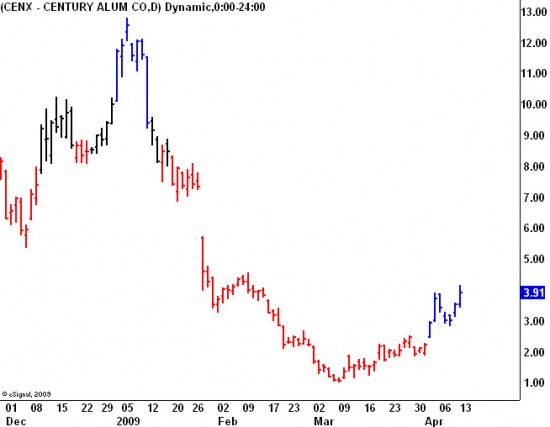
Century Aluminum
3) The FED is buying Treasuries today. As they drive the price higher, they are driving rates lower.
Peace
There isn’t much good coverage of the markets in the states. You have to fly over the pond to The Economist, owned by Pearson, a British conglomerate.
This week, The Economist nails it again in it’s article Banks and accounting standards. Messenger, shot.
I could not agree more with their assessment. I quote:
“IN PUBLIC, bankers have been blaming themselves for their troubles. Behind the scenes, they have been taking aim at someone else: the accounting standard-setters. Their rules, moan the banks, have forced them to report enormous losses, and it’s just not fair. These rules say they must value some assets at the price a third party would pay, not the price managers and regulators would like them to fetch. Unfortunately, banks’ lobbying now seems to be working. The details may be arcane, but the independence of standard-setters, essential to the proper functioning of capital markets, is being compromised. And, unless banks carry toxic assets at prices that attract buyers, reviving the banking system will be difficult.
To get the system working again, losses must be recognised and dealt with. Japan’s procrastination prolonged its crisis. America’s new plan to buy up toxic assets will not work unless banks mark assets to levels which buyers find attractive.”
In the states, the financial reporting on television is far too biased. Any financial channel owned by General Electric should be viewed with extreme caution. General Electric $GE is very over leveraged. Knowing they could not make their dividend, they assured everyone they could.
Peace.
It is my vision that, through meaningful work and collaboration, I can better myself.
Using my inspirations as a guide, I will produce things of importance, and open doors for those that believe in themselves, and build an immense store of energy.
 | Part of the TINKER FACTORY NETWORK |
