Sunday, April 12, 2026

April 20, 2009

Stop In the Name of Century Aluminum

They always say time changes things, but you actually have to change them yourself.
-Andy Warhol

I mentioned in my post from April 13th that if you thought the rally in stocks had more legs, then $CENX was a chart to consider. Obviously, with the absolute crushing taking place in the S&P 500 today, there is absolutely no reason to be long the Base Metals. Stop Out. Movin’ on. I also mentioned Hecla Mining $HL. That’s the one to double up on as you stop out from Century Aluminum.

Peace

Diluting the Equity of Banks Equals Stretched Dollars

This New York Times article is a must read. I quote:

“In a significant shift, White House and Treasury Department officials now say they can stretch what is left of the $700 billion financial bailout fund further than they had expected a few months ago, simply by converting the government’s existing loans to the nation’s 19 biggest banks into common stock.
Converting those loans to common shares would turn the federal aid into available capital for a bank — and give the government a large ownership stake in return.

While the option appears to be a quick and easy way to avoid a confrontation with Congressional leaders wary of putting more money into the banks, some critics would consider it a back door to nationalization, since the government could become the largest shareholder in several banks…
Taxpayers would also be taking on more risk, because there is no way to know what the common shares might be worth when it comes time for the government to sell them.”


To avoid having to beg for more money while being broadcast on national television, the government is carefully crafting a shift in the bailout plan. They will “stretch dollars” so that even more bank risk can be shifted to the masses. This sub plot is so obvious it cannot even be classified as “slight of hand.” There is one great trick inherent in this plan however—now you see a capitalist free market, now you don’t! With each and every new governmental “ownership stake” in private business, we creep ever closer to a socialist economy. The best ruse: they pulled the coin right out from behind our own ears!

With bailout dollars now convertible into equity, more dollars will magically appear—they have “stretched.” The pile of money is now bigger! But ask yourself, how much is a stretchy dollar worth?

The Catch
The catch is obvious: dilution. Now, the government will own a bigger share of the equity in the bank, but the equity will be diluted. This has significant ramifications for the masses. Recall when the article said, “taxpayers would also be taking on more risk.”
You are the government. Nationalized losses are your losses.

Gains for a few, losses for the masses.

Nothing changes in the markets—just the participants.

Peace

April 19, 2009

Stormy Weather

This is Mr. Volatility reporting live from around the globe on various frequencies. In the geographies I monitor, markets continue to twist and turn; some fortunes are made, others are lost. Back at headquarters, I met with top advisors last night to discuss some breaking issues.

It appears as though banker tantrums have finally earned regulator mercy in the form of eased accounting rules. Banks may now look better on paper. This indulgent clemency, of course, sent equities—including many banks that are insolvent—even higher.

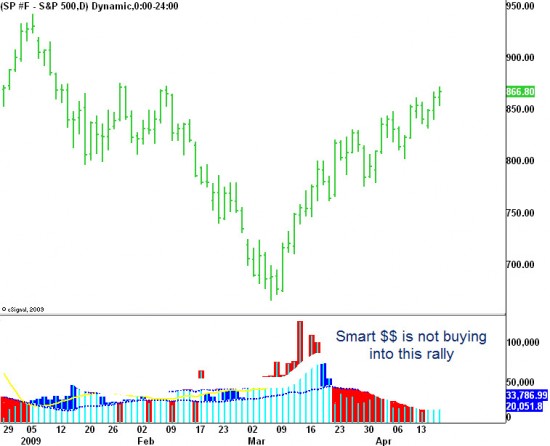
While the equity rally has been fierce in it’s gains, it is the laughing stock of the S&P pit in Chicago. As you can see from the chart below, the volume on the S&P large futures contract ($250 per point) has been dismal at best. Discussion amongst the pit traders in my fox hole elicited the perfect summation from one intellect: “Locals are not involved in this rally; it’s all the machines.”

With respect to “Terminator X — Rise of the Equities Machines,” be advised that the e-mini (front month is ES M9) futures contract is one-fifth the size of the big contract that the major players trade in the pits. Pay attention to the volume on the big contract, not the small one. The small contract is bid up by the machines. Veterans in the pit have a far better track record than the machines.

Big Institutional Money Not Participating

Big Institutional Money Not Participating


What Do the Veterans See

The banking system is no where near being fixed. This week’s Economist sums it up best in their article American banks: Payback time.

“However there is still a danger that the American banking system as a whole is nearly insolvent. And if the stress tests are rigorous, they could show that insolvency is indeed some banks’ likely fate: losses may well eat up much of the system’s capital.”

Silver Lining

There is a silver lining evident in the vast amounts of economic data that I monitor. The tenuous good news: the pace of the recession is beginning to slow. Signs of stabilization have begun to appear. These data points are key. However, we are by no means out of the woods.

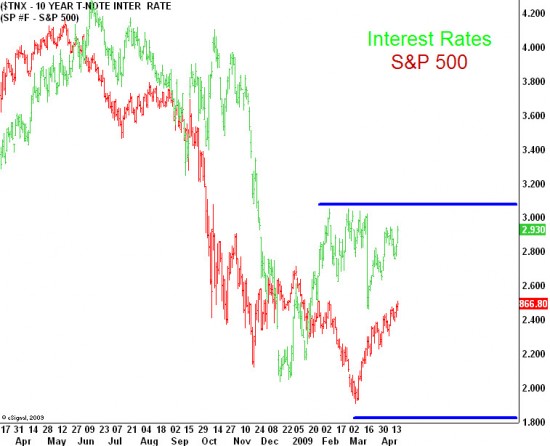
The FED sees these signs of stability, but they likely want to drive rates lower one last time. In the chart below, I show a target for the rates on the Ten Year at just below 2%. Since the FED sees we are still thick in the thicket, but can’t lower the fed funds rate any more, they can manipulate rates lower by driving Treasuries higher. The only mind on the street that sees rates going this low is David Rosenberg, outgoing chief economist at Merrill Lynch ($BAC). David shines bright in the spotlight for seeing this whole calamitous situation coming. I wouldn’t fade his opinion at this point.

On the flipside of this trade, rates could break above resistance. Given these crosscurrents, this situation will remain in the closely monitored file.

The S&P 500 and Ten Year Rates

The S&P 500 and Ten Year Rates

Weather Advisory

What is the catalyst? What will spur the sell off in equities, and therein, instigate the rally in bonds, driving rates lower? In the absence of many viable suggestions, I offer some seasonal wisdom that I return to each year: the inverse of the Halloween Indicator.

Perhaps the most important advice in the current “climate”: sell in May and go away. I have never made big gains being long equities during the summer.

Peace

April 17, 2009

The Entrepreneurial Spirit

Speaking to an assemblage of venture capitalists the other day, one of the more successful names in the room posed to me the following question:

“Of all the entrepreneurs that you have invested in, what is the most predominant feature they have in common?”

“Intellectual aggression,” I responded without delay. After all, he didn’t ask the question in search of amateurish illumination; he was hoping to appear the consummate authority.

“Please…explain,” he faltered, lacking much else to say after such an answer came back at him so quickly.

The best clarification is found in Heinz Pagel ’s reflections about scientific research in The Cosmic Code.

“A predominant feature in the conduct of scientific research is intellectual aggression, which is manifested in the desire to know and to exercise one’s intelligence in solving the enigma of the universe.

No great science was discovered in the spirit of humility. A healthy sense of ego and intellectual intolerance is crucial to the conduct of inquiry.

A colleague was complaining to me about the arrogant character of another theoretical physicist who had recently done some fine work. I replied, ‘No, you have it all backward. He has the marks of a messiah; he is a brilliant, self-confident, aggressive person who will appropriate others ideas and think they are his own. He has a one-to-one ratio of ambition to ability.’

That such men can serve the search for truth while realizing their ambition comes as no surprise to scientists. It is not because humility is a liability and we should beware it. It is because it is often fraudulent in a creative scientist, masking aggression.

Once someone pointed out a very humble young physicist to Einstein, and Einstein responded to the effect, “How can he be humble? He hasn’t done anything yet!”

Heinz Pagels, The Cosmic Code, Pg.303


Like scientists, successful entrepreneurs possess, more than determination, a compulsive curiosity that disallows rest without resolution. But each solution only serves as a catalyst to the next innovation, thus they advance and progress, becoming intellectually aggressive in the way they:

1) sell their ideas to others that will aid them, and

2) emit self-confidence and clarity with people that challenge them.

Peace

April 16, 2009

Fed Fisher Comments From Beijing

Federal Reserve Bank of Dallas President Richard Fisher quoted via Wall Street Journal.

“At least for the period over which the Fed has been applying its new tools, it has been quite true that ‘gentlemen prefer American bonds,’” noting the relatively strong performance of U.S. Treasurys relative to European government alternatives.

Ultimately, “demand for Treasurys and other official paper of U.S. government issuers will be determined by their attractiveness relative to alternatives, and they may well be judged more, rather than less, attractive under most reasonable future scenarios,” Fisher said.

The short squeeze in bonds remains in it’s infancy.

Peace

We agree, US Bonds will trade higher

We agree, US Bonds will trade higher

« Newer PostsOlder Posts »