Saturday, April 11, 2026

May 18, 2009

Barron’s on Treasuries

In one of the most absurd, inaccurate, and audacious articles of the week, Barron’s alleges that “Treasuries are in a bear market.” Equal parts silly and supercilious, they go on to presume that they have insight into the Treasuries top!

“Barron’s called a top in Treasuries and a bottom in the rest of the bond market in an early 2009 cover story.”

In hindsight (if persons so inanely bold dare to use it), this cover will look as ridiculous as their June 2nd cover story: Buy GM .

As chronicled here at Trade the Picture, Treasuries must go higher

. The Treasury market is the only viable entity left which the fed can manipulate to lower rates. The Fed Funds rate can’t be lowered—it’s as low as it can go.

By claiming that Treasuries have topped, Barron’s is essentially fighting the Fed. The casualties, no doubt, in this misguided confrontation are their countless readers. They continue to publish some of the worst coverage of financial markets the world has ever known.

At some point, Treasuries will top and a bear market will follow. Before they do, they are headed much, much higher. The price action in Treasury futures attests to this eventuality. Despite Barron’s reckless assertions and deceptive cover stories, Treasuries are not in a bear market.

10 Year Treasury Note

10 Year Treasury Note

Peace


Comments (4) Categories: US Bonds

May 15, 2009

Magazine Files 16.May.09

The Thirst For Risk

push online (Zero Hedge)

“Notable is also the collapse in M&A deal volume. The facts that companies are unwilling to spend either cash or stock currency in order to grow, should be very indicative to primary equity investors who, despite this graph demonstrating that no companies are even considering expanding in this environment, keep on purchasing follow on offerings in the crappiest of sectors for totally unfathomable reasons.”

Russia Stockpiles Diamonds, Awaiting the Return of Demand (New York Times)

“As a result, Russia has become the arbiter of global diamond prices. Its decisions on production and sales will determine the value of diamonds on rings and in jewelry stores for years to come, in one of the most surprising consequences of this recession.”

Federated’s Tice Says S&P 500 Is Poised to Plunge 62% (Bloomberg)

“The Standard & Poor’s 500 Index’s 28 percent rise since March 9 is a “sucker’s rally,” and the overvalued measure may plunge 62 percent as earnings continue to shrink, according to David Tice of Federated Investors Inc.”

David and I agree. I mention my long term target for the S&P in this comment.

Peace


Comments (0) Categories: S&P 500

May 12, 2009

Insider Protection on Wall Street

On Friday, May 8th, the unemployment numbers were released. In response to the tally of only over 500,000 lost jobs, the media rejoiced and praised the nebulous powers-that-be. Celebratory headlines chanted a harmonizing tune: “New Jobless Claims Plunge,” “Retail Sales Improve,” and “Job Figures Not as Bad as Feared.”

The number of headlines, along with enthusiasm over the so-called “stress test” results caused the S&P 500 to rally and close near its highs Friday. In the last hour of trading, the pit was full and everyone was waiting for the final hour break lower. The bond started spiking and traders were leaning short—but alas—the machines won out and bid the electronic S&P e-mini contract higher.

Here at Trade the Picture, there is no doubt that the worst of the headlines—at least in terms of the recession—are behind us. We will not see jobless claims in the 700,000’s like we saw in January, nor will we see further contraction in the economy. The decline has peaked.

That said, we are still far from a new decade of greed. There are a myriad of other concerns that deserve our attention. The first item relates to the news that started pouring in after the bell on Friday: the stress tests were rigged. Hold your shock and dismay. After all, when you allow the banks to bargain over the parameters of the tests and to negotiate the capital requirements that result, the info cannot possibly be reliable.

I quote from the Wall Street Journal: “Banks Won Concessions on Tests.”

“The Federal Reserve significantly scaled back the size of the capital hole facing some of the nation’s biggest banks shortly before concluding its stress tests, following two weeks of intense bargaining.”

“In addition, according to bank and government officials, the Fed used a different measurement of bank-capital levels than analysts and investors had been expecting, resulting in much smaller capital deficits.”

The Economist sums it up best in “Stresses and Strains.”

“The stress tests have worked in one sense. They have produced a credible estimate of the likely losses banks will face. But the second part of the test—establishing a buffer big enough to allow banks to absorb those losses and command confidence without state support—looks to have been fudged. It is still hard to imagine the banking system being able to stand on its own two feet without explicit state guarantees of debt issuance and the implicit understanding that the government would step in again. As Mr. Geithner admitted, we are only in the “early stages of repair.” The mechanics should keep their spanners at the ready.”

The amount of capital that has been raised for the banks and REITs into this run-up is stunning. In hindsight, this era will be viewed as one of the largest coordinated public shillings ever witnessed in finance.

I stated earlier that the worst of the recession is behind us. However, that does not mean that common stocks (especially of banks) are the asset class to own in the here and now. The banks will almost certainly need more support from the government. In the event that this is not the case, your primary consideration should be which asset classes you want to own during a tightening cycle. When it comes down to it, rates can only be manipulated lower for so long; inflation abounds at some point. You do not want to own banks during a tightening cycle.

Considering persistent bank debility, the amount of money raised through bank and REIT secondaries is criminal. The public is buying these secondaries, if not outright, then through mutual fund purchases in their 401k plans. When bank shares trade at far lower levels, it is the public that will be left holding the bag. While the government is protecting insiders, who is protecting the public–the outsiders?

Indeed, we are witnessing a very dark era on Wall Street.


Comments (4) Categories: trading

Trader Art

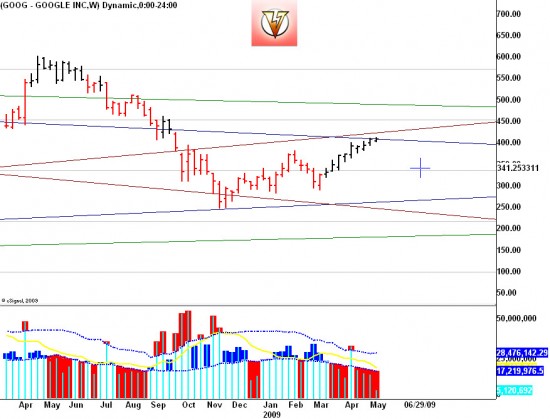
In today’s edition of Trader Art, I present the weekly chart of Google (GOOG).


As Google reaches a key level, smart money takes $30 million off the table.

Google

Google


Peace


Comments (2) Categories: Trader Art

May 8, 2009

Thursday 07.May.09 Market Recap

The machines jammed the e-mini futures contract above yesterday’s highs in the evening session last night. The rally soon fizzled when at around 8:30 AM EST this morning the socialized Manhattan bankers arrived at their proprietary (prop) desk trading turrets—the only sources of profits left in what was once known as investment banking.

When prop trading accounts for the bulk (if not the entirety) of ones revenues, how can the corporate charter retain the title Investment Bank? Perhaps it is time to revise such charters to reflect what they really are—socialized hedge funds. Unfortunately, prop trading models work brilliantly, until they don’t. Now that prop trading is broken, the already collectivist banks will become systemically more socialized thanks to the secondaries being sold to the public via the shilling on CNBC.

Case in Point: As I write, Morgan Stanley (MS) is out with a $2 billion dollar secondary offering announcement. Not to be outdone by the competition, Wells Fargo (WFC) had already announced a $6 billion dollar secondary. Scary. But not quite as ominous as the $6 billion Dow Chemical (DOW) debt offering.

But I digress.

Once US investment bank prop traders arrived at their desks, S&P futures sold off all day until the magical last half hour of equities trading. Then the machines (naturally) seized their opportunity to force up the futures a quick 12 points in about 30 minutes. The S&P and the Euro moved in tandem as the chart below illustrates. The Euro did not fluctuate as strongly as the S&P. The e-mini contract is where the wildest action was, as prop desks still live under the delusion that their quantitative models exploit some sort of edge.

S&P 500 (top) Euro (bottom)

S&P 500 (top) Euro (bottom)

The 1PM EST bond auction results sent the bond reeling and out of the range previously mentioned here at Trade the Picture.

Being long Treasury Note calls is my current “outlier” postulation of the year. This trade will work because a) mortgage rates need to stay low and they cannot if Treasuries don’t rally, and b) Treasuries move in tandem with the Volatility Index ($VIX). Restating my restatement: the Fed will squeeze the bond higher to maintain low interest (mortgage) rates, or else market volatility will return and a flight to safety will push the bond higher. Either way, it looks like a win-win for Mr. Volatility.

Other items of note:

The “Upgrade of the Day” award goes to none other than Morgan Stanley (MS) for promoting Bank of America (BAC) and awarding it a $25 price target. Look for some reciprocity in the days to come. Very likely, (BAC) will soon be handing out the promotions—promotions Morgan urgently needs given the fact they have $2 billion of equity to sell to the public.

When news of the (MS) secondary hit the wire I reached for my Bloomberg terminal to see which earthly investment bank would underwrite such an offering. The headline read to the effect of “Morgan Stanley & Co. Incorporated will serve as the sole book-runner for the offering.” Given they are representing themselves, there obviously won’t be a conflict of interest.

Speaking more to the point of secondaries, I’d like to grant a (dis)honorable mention to Jim Cramer who advised viewers that—since he’d potentially like to invest his personal charitable trust into the the ubiquitous secondaries flying all over Wall Street—they too should put their hard earned dollars into such deals. By talking his own book that doesn’t even exist due to trading restrictions, Jim sure has reserved himself a seat in the Wall Street shill hall of fame.

The quote of the day goes to Rick Santelli (see video below) who actually drew a chart on live TV today to explain where current economic policy will lead:

“We are using future revenues to fix the hole today, so we’re going to be carrying a trailer load up a hill for the next several years.”

Rick remains one of the few people on television to whom it is worthwhile listening.

Peace

« Newer PostsOlder Posts »