

Saturday, April 11, 2026

July 5, 2009

The Risk Aversion Trade

A good fight should be like a small play…but played seriously. When the opponent expands, l contract. When he contracts, l expand. And when there is an opportunity… l do not hit…it hits all by itself.
-Bruce Lee

The stock market–still fighting its formidable economic opponent–is showing signs of exhaustion after its rally from the March lows (666 on the S&P). Since the lows, It has landed some powerful punches and earned considerable gains, but lately we have seen some days of intense selling and the market has developed yet undetected “internal injuries.”

As robust as the rally has been in terms of percent gains, it has actually been bid up—bolstered—by only a very few contributors. Indicators suggest that this minority will soon be throwing in their towels, leaving the market on very unsteady legs.

On the whole, the scorecard is not looking favorable for further market gains. In fact, one might speculate (this judge is) that after this grueling bout, the market is headed down several weight classes. In the S&P 500 specifically, the next support will be below the 666 print from March.

Equities are not the only asset class headed lower. Many commodity markets have taken defensive jumps in anticipation of inflation. No, the inflation has not yet reared its unsightly head–it is still wading amidst the muck of the banks’ clogged liquidity–but it will spill over and saturate consumers soon enough. Until then, we sit high and dry in deflation.

With Treasuries and the Dollar (USD) on one side of the fiscal teeter-totter and equities and commodities on the other, we can expect some raucous fun during the inversely proportional interplay. As the dollar kicks up, all dollar denominated assets (commodities) as well as many currencies will be forced down. Some judicious shorts on the downswing will pave the way to gains: my favorites in commodity land are oil and soybeans; in currencies, the euro and the pound.

Lastly, we come to precious metals, specifically gold and silver. Long term, I am very bullish on precious metals; however, if the dollar strengthens (as I think it will), gold and silver will fall. Therefore, I am temporarily eliminating my gold positions. But when the liquidity that is stopped up in the banks resumes its flow to the consumer, the resultant inflation will buff these precious metals to an impressive sheen. I will own them again when they are shiny.

Like a fighter before the championship match, I recognize an immense opportunity and steel myself for the challenge. Fortunes are going to be made and lost…all I need to do is step out of my corner and let it “hit all by itself.”

Comments (6) Categories: Treasuries

June 29, 2009

Greenspan Speaks

In his article Inflation – the real threat to sustained recovery , Alan Greenspan points out that in the short run, the danger is deflation. In the long run, the danger is inflation. I agree with his assessment.

The most prescient words of the article he saves for last, as he sums up the inevitable outcome when government is put in charge of capital allocation:

“However, for the best chance for worldwide economic growth we must continue to rely on private market forces to allocate capital and other resources. The alternative of political allocation of resources has been tried; and it failed.”

Peace


Comments (0) Categories: trading

June 25, 2009

The Money Trap

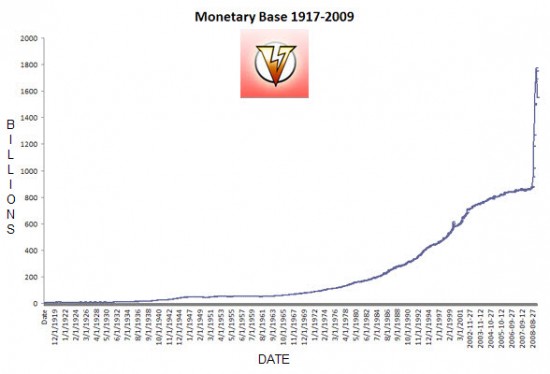
Through lower interest rates and other mechanisms, the FED is currently expanding our monetary base. (Here begins our ill-fated orb.) As the monetary base expands, more dollars are competing for the same amount of goods, causing prices to rise. Climbing prices of goods and services on a general scale is what we term “inflation.” Thus (and now we come full circle), the FED’s expansion of the monetary base is, by definition, inflationary.

Yet–there is no inflation.

There is deflation

.

In fact, The Producer Price Index is deflating at a 5.0% year-over-year (YoY) pace. We are in the thick of the worst deflationary spiral in 50 years. If the FED is expanding the monetary base at the most torrid pace we have on record, why is there no inflation? Why are we seeing the exact opposite effect?

Well, thanks to the diligent monetary expansion efforts, banks can now borrow at very low rates. This is typically an economic boon: as the capital is readily available to the banks, it moves through the system quickly and efficiently, flowing from the banks to businesses and consumers. The money flow is liquidity.

However, at present, the banks are not circulating the money. They are not loaning to businesses and consumers; they are not allowing it to flow in and out. They have dammed it up within in order to use it for their own institutional repairs. The liquidity, in essence, is clogged.

monetary-base1

Peace


Comments (3) Categories: trading

June 24, 2009

John Henry

John Henry and Mr. Volatility have many things in common. For more of the scoop on John, read this article: Red Sox Owner Gets 91% on Oil After Striking Out on $3 Billion.

“Henry started his Financial and Metals Portfolio in 1984. Two years later, it gained 61 percent; in 1987, when the Dow Jones Industrial Average tumbled 23 percent in one day, the fund soared 252 percent.”

“If he bets on a position and the market moves against him, he bails, taking a small loss. When he’s right, he holds on for gains.”

“‘We’re right 38 percent to 40 percent of the time,’ he explains. ‘The key is how much money is allocated to the winning trades.’”

Peace


Comments (4) Categories: trading

June 23, 2009

Tomorrow’s FOMC Announcement

Tomorrow (Wednesday) is a critical day. I will be watching how the market reacts to the FOMC announcement at 2:15 EST. The market is slowly breaking down. I am starting to edge into put positions. Volatility is priced very low. It is not a matter of if the market goes lower, it’s a matter of when. The crash of 2009 is on. Are you positioned correctly?

Peace

« Newer PostsOlder Posts »