

Saturday, April 11, 2026

July 13, 2009

Meredith Whitney Upgrades GS

“Like all gambling games, and virtually everything else that involves money and the element of chance, the stock market can be rigged.”
-Nicolas Darvas

Equities are showing strength today as the euro trades up a tad (about 50 pips). Financials trade firm as they benefit from a Meredith Whitney upgrade of Goldman Sachs (GS). Meredith sees Goldman as a beneficiary of the bearish outlook for the US economy.

“However, Whitney said her bullish view of Goldman is rooted in her overall bearish outlook for the U.S. economy and other U.S. financial companies. While Goldman has made most of its money in the past through a focus on equity markets, Whitney said during the next two years the firm will shift focus to the government debt markets, facilitating new issuance from local, state, federal and sovereign governments as they try to raise money to fill budget gaps.”

download i q dvdrip

This news has naturally activated call buyers in Goldman. Traders are buying about twice as many calls as they are puts into tomorrow’s 8:30 AM EST earnings release.

Though equity indices are elevated and Goldman Sachs is trading up about 5%, the momentum of the upgrade has not reached the credit market, where spreads on Goldman Sachs (and spreads in general) remain unchanged.

It is no wonder that the tape is readily marked up on a quiet Monday. The markup is designed to deflect traders from the news that should be the focus today: the CIT news.

CIT is no more. Gambler’s ruin has set in—and save intervention—once the Gambler’s hand has been played, there is no way out. Whether CIT will be bailed out or go the way of Lehman is uncertain. What is certain is that their $68 billion in liabilities, if not paid, will have a large impact on all the other banks and financials that are counterparties to the liabilities.

A few minutes ago, chair of the Council of Economic Advisers, Christina Romer was posed the question, “Does CIT fit in the ‘too big to fail category?’”

“No comment.” she said.

In this instance, “No comment,” is a significant comment in and of itself.

Comments (1) Categories: trading

July 9, 2009

Google

But if after a long steady rise a stock turns and gradually begins to go down, with only occasionally small rallies, it is obvious that the line of least resistance has changed from upward to downward.  Such being the case why should anyone ask for explanations?  There are probably very good reasons why it should go down…
-Jesse Livermore

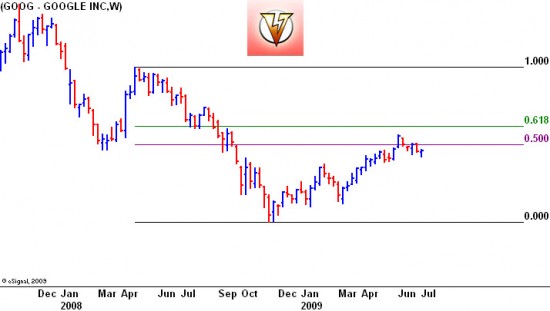
In the May 12th edition of Trade Art, I featured Google (GOOG). Google is set to announce earnings Thursday July 16th. The path of least resistance in Google is down. For that reason, and the fact that smart money (John Doerr) just took a few dollars ($30 million) off the table , I own downside insurance (puts).

Google

Google


Comments (1) Categories: trading

July 8, 2009

Ride the Volatility Higher

Meanwhile, back at The Tinker Factory, I continue to ponder the catalysts which will drive the market lower, and boost volatility higher.

At the moment, I am positioned well as my previous insights into downside insurance (puts) in a handful of markets have proven astute. Soybeans and oil have been pummeled over the last couple of days, and the beating promises to continue. As it does, my store of energy—along with my credibility—will grow.

My favorite position in the short term are puts is Alcoa (AA) and calls in the ProShares UltraShort Basic Materials ETF (SMN). Alcoa announces earnings today, and they will disappoint. Everyone else will be surprised. How can I be so sure? Among other things, Citibank initiated the stock at a buy with a $14 price target on June 25th. This is an obvious sign that things don’t look good for the quarter. Second, The CEO came over the wires yesterday and declared that “global demand for aluminum is recovering;” that China is “clearly out of the woods;” and that “US and European demand has bottomed.” Ironically, such expectant declarations prior to one’s earnings are merely a bold tell—a tell that bad news is forthcoming.

In long overdue news, Goldman Sachs finds itself mired in controversy over some stolen code. Court documents stated that “The bank (Goldman ) has raised the possibility that there is a danger that somebody who knew how to use this program could use it to manipulate markets in unfair ways.” In other words, Goldman is worried that, without the code, they

will no longer be able to manipulate markets. Moreover, if another party has it, they may now interfere with Goldman’s special market mending abilities. This is a very important story to follow. As it gains attention, price movement in the banks could get wilder than they were last fall when Lehman suffered the fate of gambler’s ruin. This story is being covered very well over at Zero Hedge. Keep an eye on developments.

Approaching a full 360 and my original point, we are positioned for a swoon in many markets, and a jump in volatility. It is tough to pinpoint the precise catalyst, but we have at least identified some deserving nominees: the deflationary crash in commodities, the earnings fumble to be reported by Alcoa (AA) this afternoon, and the Goldman controversy. All are worthy candidates—you must cast your own vote. Like Sly Stone, I want to take you higher.


Comments (2) Categories: volatility

July 7, 2009

David Rosenberg Interview

Amongst many other important data points in this interview, David Rosenberg talks bonds and bond yields:

“And for all the bond bears out there, I’ve got news for you. Seven years after incredible government largess with FDR by 1940, 1941, the long bond yield was below 2%.”

Must see video:

In his last comments, Rosie comments on inflation vs. deflation:

July 6, 2009

Making Revenue Out Of Nothing At All

Banks are no longer making money doing what they once did–banking. So instead, they have resorted to trading with each other and booking “trading revenues.” Besides tossing assets back and forth between each other and engaging in coordinated trades, they also book the shrinking value of their liabilities as revenue.

Consider the irony that the following statement implies (via Reuters):

“Trading revenue were boosted as banks wrote down fewer losses from bad loans and recorded the declining value of their debt as a liability. Banks can book the deteriorating value of their own debt as trading revenue.”

Does this sound…unorthodox? Well it is. Say a bank issues bonds at par ($100). The bonds then trade in the open market. If they trade lower than par, say at $70, then the bank can book $30 as trading revenue. The “mark to market” loss is booked as revenue, but in no way has the liability changed. They still owe the bondholder $100. Is this legal? Yes, thanks to FAS 157. As with all Ponzi finance schemes, this too will come crashing down.

Perhaps when banks miss their earnings estimates next quarter, they can simply explain that since their debt did not sufficiently decline in value, they could not book any trading gains. The squirming should be colossal.

I’ve said it before and I’ll say it again: Stay away from bank and financial stocks (including General Electric (GE)–which is the largest over-leveraged hedge fund in the world). If you are a speculator, be short.


Comments (0) Categories: trading
« Newer PostsOlder Posts »