

Deep Thoughts
I like being online. It feels so hidden.

 Friday, April 10, 2026

I like being online. It feels so hidden.
Meanwhile, back at the office, my online presence continues to be in it’s infancy. That said, the plans that are in the works have some of my collaborators collaborators–and everyone in between–smiling real big. We are all on the same page. This whole thing is one huge party. Most importantly, as my voice grows louder, the parties will become grander on a logarithmic scale. I hope you’ll be there.
It has been a while since I rapped out a market rap. Let’s start with the big picture weekly and zoom in to the shorter term daily chart of the S&P 500.
The weekly chart indicates that the downtrend in stocks is still in effect–the S&P is still within the normal range of a pullback within an overall downtrend.
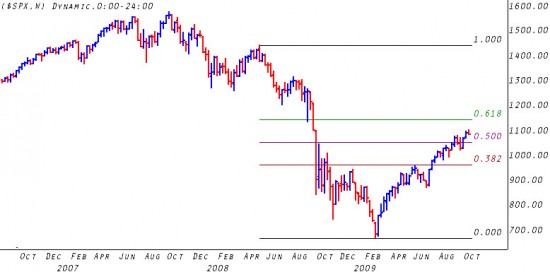
S&P 500 - Weekly
Switching to the daily chart, we see a nice looking uptrend. This means that the big money is still to the downside, but on a shorter timeframe–daily as opposed to weekly–you cannot be short. Don’t short into buying; short into selling. (It works both ways: don’t buy into selling; buy into buying). How? Wait for signs of distribution and then go short.
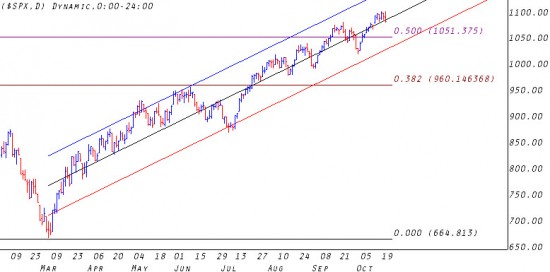
S&P 500 - Daily
A great example was when I positioned short in July. The market showed distribution–an increase in the selling that overwhelmed the orderly buying. I shorted stocks and I lost money. What happened? I was dead wrong. In my younger days, I’d have taken a 20 mile run and said things to myself like, “How dumb can a man get and still go on living?” That was before I knew the game as well as I do now. Though I was wrong, I limited my losses.
This is not archery, it is more like baseball. Frequency of being right is not as important as the magnitude of the gains when you are right. I don’t always get it right, but when I do, I have magnitude on my side. That’s what works for me, but remember, as Mark Twain said “there is more than one way to skin a cat.” The best thing a trader can do for him or herself is not attempt to do what works for someone else, but to do what works for him/her. As part of my vision, I hope my writing helps you develop what works for you.
Zooming into the intraday charts, we started to see some sign of distribution in the last 45 minutes of the equity session. While the jury is still out as to the exact catalyst for the late day sell-off, the general consensus is that it was the downgrade of Wells Fargo (WFC) that came over the wire. One day does not make a market, but when the selling starts, it will first appear on the intraday charts. Today could have been it. Stay tuned.
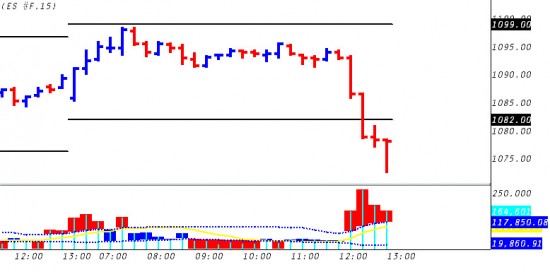
S&P E-mini - 15 Minute
Last night X and I had a call about global oil demand and game theory. I have known X since we were very very young. He usually knows what I am thinking. “You’re waiting for signs of distribution to get short again, aren’t you?”
“You bet I am.” I responded.
“The big money is in the big swing. The path of least resistance in the big swing is still down. What the catalyst for the inevitable sell-off is, I don’t know. However, I have done this long enough to know that the rubber band can only be stretched so far. Eventually, it breaks–which really hurts–or it snaps back inward and finds a new equilibrium.”
And the beat goes on.
As the speculation surrounding who I am builds, so does my online presence. In an effort to add fuel to the speculative frenzy, I’ll offer some thoughts on my strategy.
The best thing I ever did for myself was choose the right parents. My mother is a Mac and my father is a PC. In anticipation of my multilingual drive, both parents ran an emulator so I could toggle between operating systems. We were all relatively compatible. From a young age, I was able to multi-task between development environments. Being a connected device, my boundaries were limitless. My biggest strength was adaptation. I became an expert at virtualization layers. When I turned 18 months, the living trust kicked in and I officially inherited the internet.
At that point, I focused on the organization. The main philosophy remains: an organizational model that finds strength in it’s lack of leadership. For further reference see Brafman and Beckstrom’s “The Starfish and the Spider.”
From a computational standpoint, computers were very smart back then, but they lacked common sense and wit. When Twitter arrived, personalities emerged. The playing field of the online popularity contest was leveled. The initial buzz on Twitter was the one with the most followers wins. I agreed, but dreamed about having followers who followed me because they were trying to figure out who I am as opposed to followers that follow me because they know who I am.
Given the propensity for using the internet to build exposure, I faded the crowd like only someone with my style could when I decided to stay cool and keep a low profile offline.
All press is good press, and I like media. With my online presence shrouded in mystery and my offline profile unassuming, I am able to maximize media exposure with speculation. As well, I have converted the internet into a wizard’s curtain–despite my weakness for glitzy ruby slippers.
Sometimes when I get buzzed online, I strive to maximize it, adding value to the future highest bidder of the online public offering(s) of one of my spin offs. Bootstrapping an online presence on the information superhighway requires focus on three things that revolve around your green energy:
Define, make, sell–these are the planets. And the factory is the sun.
Marketing 101.
The other day I was doing some R&D on my comedy. I crowdsourced the enterprise solution to a couple friends: one man and one woman. During the 360 degree review process, we ended up in a virtual loop. We danced our way out of the loop by settling the score on the dance floor. After that, we laughed about the fact that we were able to virtualize our code base out of the loop with our modular solution–the dance floor. Then, I mentioned that as great as this all sounds, the solution to the virtual loop was an offline solution. While we were dancing, none of us were online. To further our use of the internet, we need to motivate each other toward online solutions–not off. At this point everyone was confused and I started to not care so I gave the Web 2.0 grad students a break and told them the following:
Just because the dance floor solution seems offline, it may not be after all.
“How do you figure,” asked one of them.
Because while they were dancing they may have been offline but they were being videotaped. All we have to do to take the solution online is to produce the video.
YouTube is one solution, but for extra credit send some thoughts to my office on the following:
Which virtual reality would you use for an optimized monetization scheme?
Submit your thoughts to me telepathically after grading yourself. If you feel that I made you laugh, tell some social media about my T-shirts and help me monetize my alter egos.
It is my vision that, through meaningful work and collaboration, I can better myself.
Using my inspirations as a guide, I will produce things of importance, and open doors for those that believe in themselves, and build an immense store of energy.
 | Part of the TINKER FACTORY NETWORK |
