

Thursday, April 9, 2026

November 18, 2009

Silver

Meanwhile, back at the factory, quite a few of you out there–that’s you my readership connection–have made it a point to let me know that many voices of the market are bearish on gold, including Robert Prechter of Elliott Wave Principle fame.

I’ve never met Robert personally, though I do remember when he won the US Trading championship in ‘84. I am unsure if he trades actively now. No matter–the point is that he and I have opposite opinions. He thinks precious metals are going to trade at lower prices and I think they are going to trade at much higher prices. Now that the opinions are out on the table, I am happy to report that my bankroll continues to be where my mouth is.

The precious metals–gold and silver–must go higher. They can’t not.

And the beat goes on.
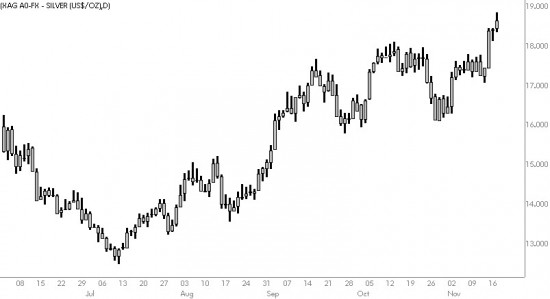
Silver - Daily

Silver - Daily

In the modern world, silver bullion has the ISO currency code XAG. The name of the United Kingdom monetary unit “pound” (£) reflects the fact that it originally represented the value of one troy pound of sterling silver. In the 1800s, many nations, such as the United States and Great Britain, switched from silver to a gold standard of monetary value, then in the 20th century to fiat currency. -Wikipedia

November 13, 2009

Market Outlook 13.November.2009

Risk on trade is on.
Stocks up, dollar down, gold up.
Next year comes the storm.

S&P/Gold/Greenback

S&P/Gold/Greenback

Volatility Radio - Break On Through

You know the day destroys the night
Night divides the day
Tried to run, tried to hide
Break on through to the other side
-The Doors

Dedication: Wisdom Addict

November 12, 2009

Oil Volatility

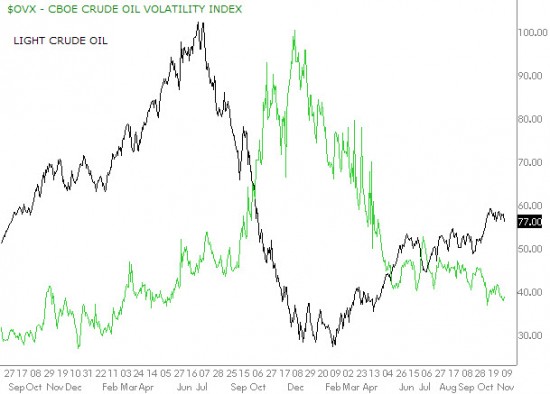
Oil futures trade at $70 as I write. As the price of crude crashed lower last year, volatility (insurance, derivatives) in the underlying contracts increased in price. Inverse movement that can be played either way, or hedged and levered.

Crude Oil Volatility / Crude Oil

Crude Oil Volatility / Crude Oil

Soros: The Crash of 2008

Meanwhile, back at the headquarters of my for profit think tank, I read George’s book today, The Crash of 2008 and What It Means. If you are interested in his view of the inter-market relationships and forces that were in place during the banking collapse last year, I recommend it. He traded actively during 2008, and he lays out the thought process(es) behind his positioning. He is a decent critic of himself in that he admits to many mistakes. He ended 2008 “modestly higher”, which he considers an accomplishment in a “period of almost universal wealth destruction.”

He candidly admits to missing the largest part of the crash, “Although I am an experienced short seller, I got caught several times, and in the end I largely missed the biggest downdraft, which came in October and November.”

He also talks to being slow to recognize the trend reversal (strength) in the dollar, causing him to give back profits. “Eventually I understood that the strength of the dollar was due not to people choosing to hold dollars but to their inability to maintain or roll over their dollar obligations. In a very real sense, the strength of the dollar, like the fever associated with sickness, was a measure of the disruption of the financial system.”

While the collapse was decently predicted, the rush to the dollar caught most off guard. Most traders–even the ones that made a killing being short the mortgage and mortgage related markets–would agree: it was surprising that the risk aversion trade became buying the dollar–the currency at the center of the collapse.

Green Energy

As the housing bubble that led to the collapse of 2008 deflates, another is being built. The massive investment in cleaner, more efficient distribution of energy is the next great growth industry. I invest heavily in energy. It is, after all, the mother of all markets. I’ll end with my favorite line of the book:

“Nothing is quite as profitable as investing in an early-stage bubble.”

And the beat goes on.

« Newer PostsOlder Posts »