

Saturday, April 4, 2026

April 23, 2009

How the Fed Will Ease Rates

The Treasury is soon to make a stunning announcement.

In my post from April 19th, Stormy Weather, I noted that the fed can drive rates lower by driving Treasuries higher.

This outlier move in Treasuries has been a central theme in these pages. Except for one thing. I never revealed the catalyst. What will be the catalyst? The Quantitative easing they announced in their 300 billion Treasury buy back plan has been shrugged at. To you, my readers, I will now reveal the catalyst.

Often when I explain what a catalyst will be, I do it by taking a page, out of our history.This article from November, 2001 from the New York times talks of what the Treasury Department was up to way back in 2001. History doesn’t repeat, but it often rhymes.

The Treasury Department’s decision to stop selling 30-year bonds could help push longer-term rates lower for reasons that have less to do with the economy than with the mechanics of the bond market. With no new 30-year bonds, more investors who want to own long-term bonds backed by the government will buy the Treasury’s 10-year note, which influences the interest rates on home mortgages. The added demand will push the price of the 10-year bond higher, and the yield, which moves in the opposite direction, lower. With the 10-year rate and related rates falling, mortgage rates will fall, too.

The Treasury Department will stop selling the 30 Year, which will push up demand for the Ten Year, driving rates lower. Is the strength in the housing index anticipating this? Driving mortgage rates even lower would allow a massive refi and write down cycle in residential mortgages. Just what the economy needs, to finally take flight again. Then what happens? They’ll do what they did then. Offer the 30 year for sale again. Same cycles, different players.

I wonder when they’ll announce it? During the market? After? Before? Who knows? Whenever they do, it will be a shock to everybody. Everybody but those who read me. Mr. Volatility.

Peace
April 19, 2009

Stormy Weather

This is Mr. Volatility reporting live from around the globe on various frequencies. In the geographies I monitor, markets continue to twist and turn; some fortunes are made, others are lost. Back at headquarters, I met with top advisors last night to discuss some breaking issues.

It appears as though banker tantrums have finally earned regulator mercy in the form of eased accounting rules. Banks may now look better on paper. This indulgent clemency, of course, sent equities—including many banks that are insolvent—even higher.

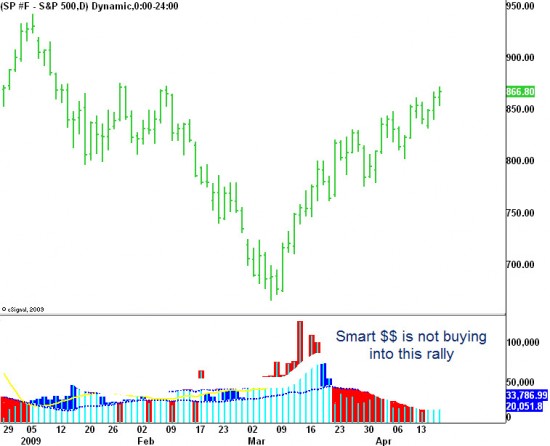
While the equity rally has been fierce in it’s gains, it is the laughing stock of the S&P pit in Chicago. As you can see from the chart below, the volume on the S&P large futures contract ($250 per point) has been dismal at best. Discussion amongst the pit traders in my fox hole elicited the perfect summation from one intellect: “Locals are not involved in this rally; it’s all the machines.”

With respect to “Terminator X — Rise of the Equities Machines,” be advised that the e-mini (front month is ES M9) futures contract is one-fifth the size of the big contract that the major players trade in the pits. Pay attention to the volume on the big contract, not the small one. The small contract is bid up by the machines. Veterans in the pit have a far better track record than the machines.

Big Institutional Money Not Participating

Big Institutional Money Not Participating


What Do the Veterans See

The banking system is no where near being fixed. This week’s Economist sums it up best in their article American banks: Payback time.

“However there is still a danger that the American banking system as a whole is nearly insolvent. And if the stress tests are rigorous, they could show that insolvency is indeed some banks’ likely fate: losses may well eat up much of the system’s capital.”

Silver Lining

There is a silver lining evident in the vast amounts of economic data that I monitor. The tenuous good news: the pace of the recession is beginning to slow. Signs of stabilization have begun to appear. These data points are key. However, we are by no means out of the woods.

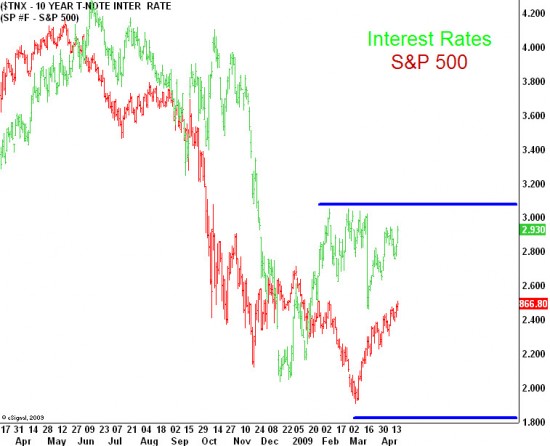
The FED sees these signs of stability, but they likely want to drive rates lower one last time. In the chart below, I show a target for the rates on the Ten Year at just below 2%. Since the FED sees we are still thick in the thicket, but can’t lower the fed funds rate any more, they can manipulate rates lower by driving Treasuries higher. The only mind on the street that sees rates going this low is David Rosenberg, outgoing chief economist at Merrill Lynch ($BAC). David shines bright in the spotlight for seeing this whole calamitous situation coming. I wouldn’t fade his opinion at this point.

On the flipside of this trade, rates could break above resistance. Given these crosscurrents, this situation will remain in the closely monitored file.

The S&P 500 and Ten Year Rates

The S&P 500 and Ten Year Rates

Weather Advisory

What is the catalyst? What will spur the sell off in equities, and therein, instigate the rally in bonds, driving rates lower? In the absence of many viable suggestions, I offer some seasonal wisdom that I return to each year: the inverse of the Halloween Indicator.

Perhaps the most important advice in the current “climate”: sell in May and go away. I have never made big gains being long equities during the summer.

Peace

April 16, 2009

Fed Fisher Comments From Beijing

Federal Reserve Bank of Dallas President Richard Fisher quoted via Wall Street Journal.

“At least for the period over which the Fed has been applying its new tools, it has been quite true that ‘gentlemen prefer American bonds,’” noting the relatively strong performance of U.S. Treasurys relative to European government alternatives.

Ultimately, “demand for Treasurys and other official paper of U.S. government issuers will be determined by their attractiveness relative to alternatives, and they may well be judged more, rather than less, attractive under most reasonable future scenarios,” Fisher said.

The short squeeze in bonds remains in it’s infancy.

Peace

We agree, US Bonds will trade higher

We agree, US Bonds will trade higher

April 14, 2009

Trader Art

Physicists love to make jokes about their work and it’s implications. It occurs to them that “the eternal maker of enigmas” might also be a trickster.
-Heinz Pagels

In today’s edition of Trader Art, I present the 3rd in my series on the the Ten Year U.S. Treasury Note. For those that do not follow Bond futures, this picture mirrors the ETF symbol $IEF. The first in the series can be found in my post from March 2nd. The second is from my post April 5th.

To explain the relevance of this piece, I quote myself:

“As the mathematics begin to work in my favor, I always adjust my risk.”

Trader Art 3/^+*

Trader Art 3/^+*

Peace

April 1, 2009

The Dollar and the Bond

“The reason the dollar is strong right now is because investors consider the United States the strongest economy in the world, with the most stable political system in the world.  I don’t believe that there’s a need for a global currency.”
-Barack Obama
March 28, 2009

In many of my musings here at Trade the Picture, I have written of the dollar being a short and US bonds being a short. I believe this to be true AT SOME POINT. I was not sure when that would be. I have more clarity now. The bond and the dollar are not shorts here and now. It is my thesis that the dollar and the bond will rally fiercely. As this happens, equities will weaken to new lows.

The Bond and the dollar are the same. They move together. Think about who needs the dollar stronger. First, the United States does. We are starting to hear the President stress this fact. Second, China needs the dollar strong. Why? Because their currency is pegged to the dollar. Why else? Because they are the largest holder of US bonds.

The shills on TV keep declaring a bottom in equities. The shills don’t trade. The only thing the shills want are viewers, so they can sell advertising. Why do people even bother watching the propaganda that the television feeds them? I think I know why. History. If history has taught us anything, it’s that history teaches us nothing. Knowing this, the TV shills will continue their game. Meanwhile the cycles that have happened over and over again will play out.

Peace

« Newer PostsOlder Posts »