

Trader Art - SPX Weekly
In my May 6th edition of Trader Art, I painted the index and spoke of a key inflection point.
The inflection point proved correct. The market will now fall to it’s next inevitability, the 800 level.
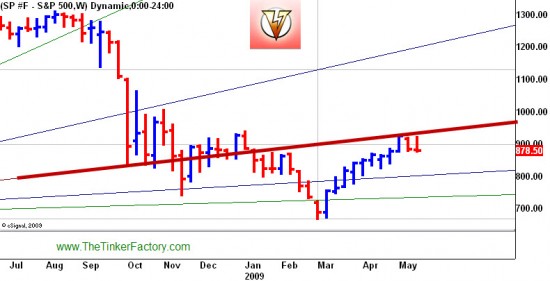
SPX Futures Weekly
Peace

 Wednesday, April 8, 2026

In my May 6th edition of Trader Art, I painted the index and spoke of a key inflection point.
The inflection point proved correct. The market will now fall to it’s next inevitability, the 800 level.
SPX Futures Weekly
Peace
The Volatility Index (VIX) has continued its perilous plunge from the heights of its October summit. Why hasn’t it caught an outcropping yet? Perhaps it is because the Index is not reflecting the underlying stress in the market. The core reasons for this are tri-fold:
First, quant funds are selling index volatility and buying volatility in individual names, which has a masking effect.
Second, the season of quazi-investors reaching for returns by selling huge call positions is upon us.
Third, The FED and it’s media have been so successful in augmenting bank sentiment that they have procured a huge boost in their common equities. This has allowed billions upon billions of dollars to be raised in common stocks of banks. Consequently, the equity offerings that have been raised of late will need to be further diluted. The stress tests were rigged, and the adverse case scenarios were far too optimistic.
Where does this all lead? For my money, I continue to own size in Ten Year calls. I am also finding safe footing in select miners and precious metal names.
The crash of 2009 is mounting, but so too is my strategy. The Ten Year goes far, far higher. In spite of all government efforts and their media machine, I veer not from my position. There is a wild outlier push coming in Treasuries, and rates will go below 2%. The FED has skillfully driven the market higher, but their trade will unwind; and as it does, the (VIX) and Treasuries will soar. Very few will be prepared. Peak earnings require a slow, methodical trek—and patience is one of my gifts.
When the climb of this year is over and my gains reach their crest—multiplying exponentially—my musings will see a larger audience. It’s a little known fact of the market that one’s net worth equals one’s net voice. Do you hear me yet?
Peace
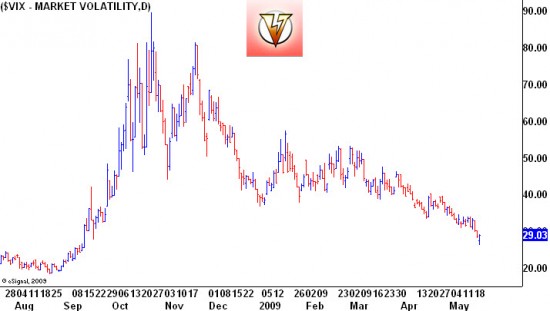
The VIX
On Friday, May 8th, the unemployment numbers were released. In response to the tally of only over 500,000 lost jobs, the media rejoiced and praised the nebulous powers-that-be. Celebratory headlines chanted a harmonizing tune: “New Jobless Claims Plunge,” “Retail Sales Improve,” and “Job Figures Not as Bad as Feared.”
The number of headlines, along with enthusiasm over the so-called “stress test” results caused the S&P 500 to rally and close near its highs Friday. In the last hour of trading, the pit was full and everyone was waiting for the final hour break lower. The bond started spiking and traders were leaning short—but alas—the machines won out and bid the electronic S&P e-mini contract higher.
Here at Trade the Picture, there is no doubt that the worst of the headlines—at least in terms of the recession—are behind us. We will not see jobless claims in the 700,000’s like we saw in January, nor will we see further contraction in the economy. The decline has peaked.
That said, we are still far from a new decade of greed. There are a myriad of other concerns that deserve our attention. The first item relates to the news that started pouring in after the bell on Friday: the stress tests were rigged. Hold your shock and dismay. After all, when you allow the banks to bargain over the parameters of the tests and to negotiate the capital requirements that result, the info cannot possibly be reliable.
I quote from the Wall Street Journal: “Banks Won Concessions on Tests.”
“The Federal Reserve significantly scaled back the size of the capital hole facing some of the nation’s biggest banks shortly before concluding its stress tests, following two weeks of intense bargaining.”
“In addition, according to bank and government officials, the Fed used a different measurement of bank-capital levels than analysts and investors had been expecting, resulting in much smaller capital deficits.”
The Economist sums it up best in “Stresses and Strains.”
“The stress tests have worked in one sense. They have produced a credible estimate of the likely losses banks will face. But the second part of the test—establishing a buffer big enough to allow banks to absorb those losses and command confidence without state support—looks to have been fudged. It is still hard to imagine the banking system being able to stand on its own two feet without explicit state guarantees of debt issuance and the implicit understanding that the government would step in again. As Mr. Geithner admitted, we are only in the “early stages of repair.” The mechanics should keep their spanners at the ready.”
The amount of capital that has been raised for the banks and REITs into this run-up is stunning. In hindsight, this era will be viewed as one of the largest coordinated public shillings ever witnessed in finance.
I stated earlier that the worst of the recession is behind us. However, that does not mean that common stocks (especially of banks) are the asset class to own in the here and now. The banks will almost certainly need more support from the government. In the event that this is not the case, your primary consideration should be which asset classes you want to own during a tightening cycle. When it comes down to it, rates can only be manipulated lower for so long; inflation abounds at some point. You do not want to own banks during a tightening cycle.
Considering persistent bank debility, the amount of money raised through bank and REIT secondaries is criminal. The public is buying these secondaries, if not outright, then through mutual fund purchases in their 401k plans. When bank shares trade at far lower levels, it is the public that will be left holding the bag. While the government is protecting insiders, who is protecting the public–the outsiders?
Indeed, we are witnessing a very dark era on Wall Street.
Elliott Management Sees Economic Disaster Brewing (New York Times)
“In its latest letter to investors, Elliott Management, a hedge fund run by Paul Singer that specializes in distressed investments, warns that the current wave of government bailouts and stimulus spending will not work and could ultimately make the economic situation worse.”
Note: You have to read this stuff in the papers. Comments like these are not broadcast on television.
Goodbye David Rosenberg (Zero Hedge)
“Never be a slave to the data – they are no substitute for astute observation of the big picture.”
We Gravitate Toward Our Self-Talk (Trader Feed)
“In all these ways, how we think affects how we feel and how we act. Our self-talk constructs our personal reality and helps define the behavioral options open to us.”
Peace
ADP job figures hit the tape at 5:15 EST this morning; within one minute the machines had bid up the e-mini futures contract 10 points. With its surplus time, the market then consolidated most of the day around the prevailing highs. 10 Year Treasury Note
Meredith Whitney—the recipient of death threats for calling the banks out on their shenanigans long before the mainstream press deigned to comment—spoke out today warning of the bubble in credit card debt that is soon to burst. She was quickly disregarded, as Capital One Financial was bolstered by the stress test results and an upgrade. After the bell, $COF traded even higher based on reports from the Wall Street Journal that they “do not need to bolster their capital.”
Things of note:
The NASDAQ was a clear underperformer today. While the Dow and S$P futures closed above yesterday’s highs, Nasdaq futures fell short.
Despite the strength in the tape, the Philadelphia Housing Sector Index $HGX closed off just over 2 1/4%.
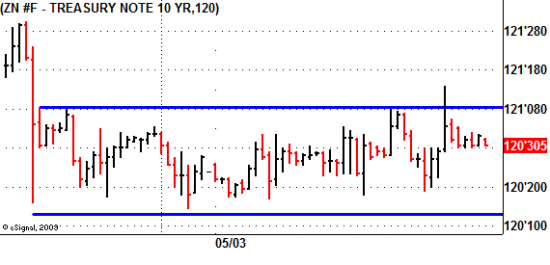
In spite of the weak dollar USD, the Treasury Note ZN_F held firm. It remains in the range I discussed in yesterday’s post.
In the trading pits, all eyes have been on Friday. The stress test results are due to be released Thursday after the bell and unemployment numbers are to be released Friday before the open.
The stress test results have been inadvertently (or not inadvertently) leaked to the media—surely Timothy Geithner is applying mascara in preparation for his interview with Charlie Rose as I write. He will not be remiss in reminding us what has already been leaked: banks need an immense amount of capital, but everything is going to be just fine!
Peace.
It is my vision that, through meaningful work and collaboration, I can better myself.
Using my inspirations as a guide, I will produce things of importance, and open doors for those that believe in themselves, and build an immense store of energy.
 | Part of the TINKER FACTORY NETWORK |
