In his article Inflation – the real threat to sustained recovery , Alan Greenspan points out that in the short run, the danger is deflation. In the long run, the danger is inflation. I agree with his assessment.
The most prescient words of the article he saves for last, as he sums up the inevitable outcome when government is put in charge of capital allocation:
“However, for the best chance for worldwide economic growth we must continue to rely on private market forces to allocate capital and other resources. The alternative of political allocation of resources has been tried; and it failed.”
Peace
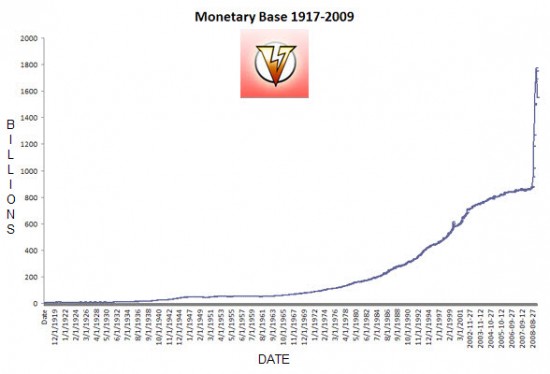
Through lower interest rates and other mechanisms, the FED is currently expanding our monetary base. (Here begins our ill-fated orb.) As the monetary base expands, more dollars are competing for the same amount of goods, causing prices to rise. Climbing prices of goods and services on a general scale is what we term “inflation.” Thus (and now we come full circle), the FED’s expansion of the monetary base is, by definition, inflationary.
Yet–there is no inflation.
There is deflation
.
In fact, The Producer Price Index is deflating at a 5.0% year-over-year (YoY) pace. We are in the thick of the worst deflationary spiral in 50 years. If the FED is expanding the monetary base at the most torrid pace we have on record, why is there no inflation? Why are we seeing the exact opposite effect?
Well, thanks to the diligent monetary expansion efforts, banks can now borrow at very low rates. This is typically an economic boon: as the capital is readily available to the banks, it moves through the system quickly and efficiently, flowing from the banks to businesses and consumers. The money flow is liquidity.
However, at present, the banks are not circulating the money. They are not loaning to businesses and consumers; they are not allowing it to flow in and out. They have dammed it up within in order to use it for their own institutional repairs. The liquidity, in essence, is clogged.
Peace
John Henry and Mr. Volatility have many things in common. For more of the scoop on John, read this article: Red Sox Owner Gets 91% on Oil After Striking Out on $3 Billion.
“Henry started his Financial and Metals Portfolio in 1984. Two years later, it gained 61 percent; in 1987, when the Dow Jones Industrial Average tumbled 23 percent in one day, the fund soared 252 percent.”
“If he bets on a position and the market moves against him, he bails, taking a small loss. When he’s right, he holds on for gains.”
“‘We’re right 38 percent to 40 percent of the time,’ he explains. ‘The key is how much money is allocated to the winning trades.’”
Peace
Tomorrow (Wednesday) is a critical day. I will be watching how the market reacts to the FOMC announcement at 2:15 EST. The market is slowly breaking down. I am starting to edge into put positions. Volatility is priced very low. It is not a matter of if the market goes lower, it’s a matter of when. The crash of 2009 is on. Are you positioned correctly?
Peace
The Bank of America / Merrill Lynch merger smelled of corruption even when the “deal” was just a rumor.
Now, a house committee has subpoenaed the FED. Not surprisingly, the FED has not been forthcoming with documents related to the merger.
When the merger was announced, I suggested the deal resembled Enron’s attempt to be rescued by Dynegy.
Now that the government is issuing subpoenas, the stories will share another ominous device—paper shredders.
Peace


 Wednesday, April 8, 2026