


Wednesday, April 8, 2026

July 29, 2009

The Inverse Of Liquidity

Observing the markets aboard The Errol Flynn today, my perpetual deliberation turned inward and I questioned whether I am who I think I am, or if my algorithmic complexity is the outcome of an undercover experiment in Artificial Intelligence. The answer is illusive, but—as with all things essential—it will find me. In the meantime, I will continue to do what I do best—speculate.

On the matter of speculation: we are beginning to see mounting clues regarding an imminent liquidity crisis. And as those of us who are following the lesson plan know, the inverse of liquidity is volatility. Being positioned correctly in front of a large move in volatility is where the big gains—the gains that break world records—will be made. The VXX (chart below) is starting to show signs of an upward move. As this moves higher, the ramifications for other asset classes are immense. Given the fragility of the underlying structure of the markets, I would not be surprised to see moves lower in equities exceeding 10 or 15% in a day.

Speaking with another trader the other night, I reminisced about trading to the long side in 1998. The sell-off triggered by the demise and rescue of Long Term Capital Management led to huge gains in the final quarter. In the summer of 1999, I questioned whether the gains in 1999 could ever match the achievements of 1998. To my surprise and elation, the gains in 99 not only met those of 98, but surpassed them by many multiples.

We saw massive gains (on the short side) in 2008. 2009 has all the structural forces in place to repeat the short side gains of 98—an enormous amount.
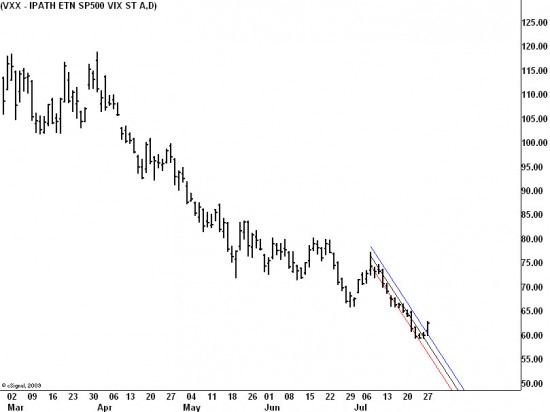
VXX

VXX

July 26, 2009

The Game

Back at the office, following some thought-provoking remote viewing sessions with financial powers around the world, I continue to ponder just how high this market will rally. The S&P is up 11% since July 10th. Remarkable as this may be, it could of course trade far higher.

In the trading world, there is a very fine line between work and play, especially since the market is essentially a game—a game of strategy and intrigue, risk and reward—always ending in triumphant wins and devastating losses. The best players know that the jackpot is built upon the big trades—the outliers.

While most games include specific instructions and a clear format for play, the best the market player can do is study the speculative paper that has the potential for the largest risk adjusted return. Though the market of late has given traders numerous reasons to stretch their security, the tide is going to turn.  Traders will have to unload risk, and in doing so, trigger volatility. And when volatility spikes, big gains materialize.

Though often the rules are vague and the players, fickle, we are compelled to keep playing…because the mystery is never truly solved.

July 13, 2009

Meredith Whitney Upgrades GS

“Like all gambling games, and virtually everything else that involves money and the element of chance, the stock market can be rigged.”
-Nicolas Darvas

Equities are showing strength today as the euro trades up a tad (about 50 pips). Financials trade firm as they benefit from a Meredith Whitney upgrade of Goldman Sachs (GS). Meredith sees Goldman as a beneficiary of the bearish outlook for the US economy.

“However, Whitney said her bullish view of Goldman is rooted in her overall bearish outlook for the U.S. economy and other U.S. financial companies. While Goldman has made most of its money in the past through a focus on equity markets, Whitney said during the next two years the firm will shift focus to the government debt markets, facilitating new issuance from local, state, federal and sovereign governments as they try to raise money to fill budget gaps.”

download i q dvdrip

This news has naturally activated call buyers in Goldman. Traders are buying about twice as many calls as they are puts into tomorrow’s 8:30 AM EST earnings release.

Though equity indices are elevated and Goldman Sachs is trading up about 5%, the momentum of the upgrade has not reached the credit market, where spreads on Goldman Sachs (and spreads in general) remain unchanged.

It is no wonder that the tape is readily marked up on a quiet Monday. The markup is designed to deflect traders from the news that should be the focus today: the CIT news.

CIT is no more. Gambler’s ruin has set in—and save intervention—once the Gambler’s hand has been played, there is no way out. Whether CIT will be bailed out or go the way of Lehman is uncertain. What is certain is that their $68 billion in liabilities, if not paid, will have a large impact on all the other banks and financials that are counterparties to the liabilities.

A few minutes ago, chair of the Council of Economic Advisers, Christina Romer was posed the question, “Does CIT fit in the ‘too big to fail category?’”

“No comment.” she said.

In this instance, “No comment,” is a significant comment in and of itself.


Comments (1) Categories: trading

July 9, 2009

Google

But if after a long steady rise a stock turns and gradually begins to go down, with only occasionally small rallies, it is obvious that the line of least resistance has changed from upward to downward.  Such being the case why should anyone ask for explanations?  There are probably very good reasons why it should go down…
-Jesse Livermore

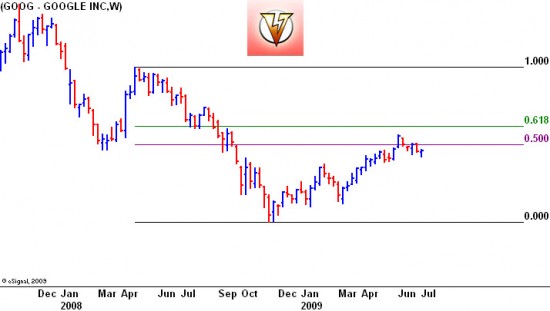
In the May 12th edition of Trade Art, I featured Google (GOOG). Google is set to announce earnings Thursday July 16th. The path of least resistance in Google is down. For that reason, and the fact that smart money (John Doerr) just took a few dollars ($30 million) off the table , I own downside insurance (puts).

Google

Google


Comments (1) Categories: trading

July 6, 2009

Making Revenue Out Of Nothing At All

Banks are no longer making money doing what they once did–banking. So instead, they have resorted to trading with each other and booking “trading revenues.” Besides tossing assets back and forth between each other and engaging in coordinated trades, they also book the shrinking value of their liabilities as revenue.

Consider the irony that the following statement implies (via Reuters):

“Trading revenue were boosted as banks wrote down fewer losses from bad loans and recorded the declining value of their debt as a liability. Banks can book the deteriorating value of their own debt as trading revenue.”

Does this sound…unorthodox? Well it is. Say a bank issues bonds at par ($100). The bonds then trade in the open market. If they trade lower than par, say at $70, then the bank can book $30 as trading revenue. The “mark to market” loss is booked as revenue, but in no way has the liability changed. They still owe the bondholder $100. Is this legal? Yes, thanks to FAS 157. As with all Ponzi finance schemes, this too will come crashing down.

Perhaps when banks miss their earnings estimates next quarter, they can simply explain that since their debt did not sufficiently decline in value, they could not book any trading gains. The squirming should be colossal.

I’ve said it before and I’ll say it again: Stay away from bank and financial stocks (including General Electric (GE)–which is the largest over-leveraged hedge fund in the world). If you are a speculator, be short.


Comments (0) Categories: trading
« Newer PostsOlder Posts »