Wednesday, April 8, 2026

August 19, 2009

Number 9 Number 9

Number nine, number nine
Industry allows financial imbalance
-The Beatles, Revolution 9

As repeatedly noted, the number 9 is one of significance, and there have been historic market events in the years ending in the number 9.

The ninth month of 2009 is approaching. It is no accident that The Beatles are releasing their digitally remastered catalogue on 9-9-09.

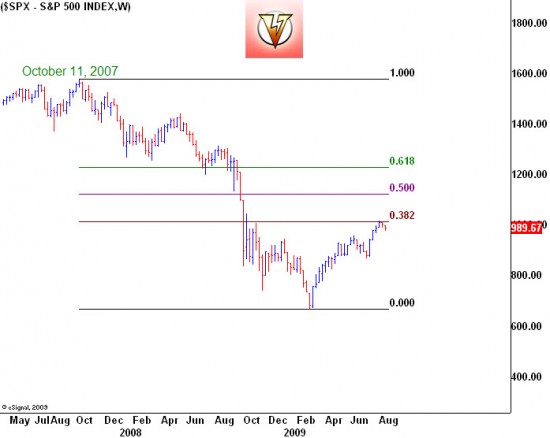
As Jeff Cooper points out, the S&P topped on October 11, 2007. In March of this year, it found support at 666. The March low was 666 days from the October high.

Number nine, number nine
Industry allows financial imbalance

Timing Is Everything

Timing Is Everything

Risk Aversion and Leveraged ETFs

As the days progress, the signs point all in one direction: that risk is vastly undervalued. We may not see it this undervalued for many years to come. My risk aversion positioning remains intact.

Since July 10, I called the flop and the market raised. Coming from a position of strength, I re-raised. The market called and now it’s time for the turn. Whatever the turn is, I’ll commit more.

Speaking to my traders today about which paper to buy, our discussions turned to the advantages of leveraged ETFs. Pro Shares is being sued over these products because of the inherent whipsaw volatility risk (h/t Sober Look).

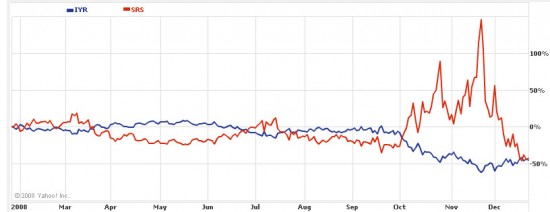
These products are advantageous in times of extreme volatility because (as the below chart shows) accelerations in velocity are observed.

Acceleration

Acceleration

August 17, 2009

Quantitative Easing Is Old School

The Shrink forwarded me a great article on the exploits of Larry Law and his attempts at quantitative easing before the French Revolution in 1789.

Add The French Revolution to the list of events that took place in a year that ends in 9.

“But one lesson from Law’s sorry tale endures: attempts to maintain asset prices above their fundamental value are eventually doomed to failure.”

“So a vicious circle was created, in which a growing money supply was needed to bolster the share price of the Mississippi company and a rising share price was needed to maintain confidence in the system of paper money. You can see parallels with recent times, in which money was lent on the back of rising asset prices, and higher prices gave banks the confidence to lend more money.”

“When the scheme faltered Law resorted to a number of rescue packages, many of which have their echoes 300 years later. One was for the bank to guarantee to buy shares in the Mississippi company at a set price (think of the various government asset-purchase schemes today). Then the company took over the bank (a rescue along the lines of Fannie Mae and Freddie Mac).”


Comments (2) Categories: trading

Confidence Trick

A confidence trick is a scheme in which the victim is defrauded after you have gained his trust. How was George C. Parker able to sell The Brooklyn Bridge twice a week for many years? By gaining people’s confidence.

Sometimes confidence is gained by deflection. As Fannie and Freddie are kept alive with hundreds of billions of dollars of capital injections, the public is slowly convinced that the deception of the past won’t be repeated. All the while, another player steps in. Her name is Ginnie Mae. She is guaranteeing loans that require very little down and have no credit score requirement. Subprime lending is alive and well. The only shift is the players have changed. When disaster repeats, taxpayers will (once again) be the guarantor of last resort.

“Fannie and Freddie are now being conservative about writing new business, but Ginnie is enjoying its own bull market, issuing guarantees at a furious rate. It is expected to have a trillion dollars outstanding by next year. “We are seeing a gravitation of the subprime universe from Fannie and Freddie to Ginnie”, says Mr Setia (Rajiv Setia of Barclays Capital). It will be a miracle if taxpayers get their money back from Fannie and Freddie. Worse, there is a chance the disaster will be repeated.” (The Economist)

Nothing changes in the markets, just the players.

August 16, 2009

Observations

The tide is high but I’m holding on
-Blondie

It ain’t over ’til it’s over
-Yogi Berra

Since the March lows, the S&P 500 has rallied roughly 50%. There are two forces that determine market prices: buyers and sellers. In a healthy uptrend, buyers overwhelm sellers, demand far exceeds supply, and prices are propelled higher.

On the flip side, markets can be moved higher without a huge increase in demand. This happens when sellers retreat. In short, the market can be moved higher on weak demand so long as supply is even weaker.

Since the lows, buying has lacked vigor and sellers have all but vanished. These observations have been the primary thrust behind my risk aversion thesis.

In the last couple of weeks, I have observed small improvements in both volume and demand. This change is worth noting as it differs from the behavior seen since March. Notable as this change is, it is only one of many data points. The most important observation in reference to this improvement is follow through. Will volume and demand continue to improve? If the market begins to retrace, will heavy selling emerge? For the time being, traders are finding every reason to increase their risk. At some point, de-risking will replace re-risking, and sellers will overwhelm buyers.

There are a myriad of data points–both technical and fundamental–that lead me to believe the March low was not THE LOW. As mentioned, the rally from the march lows was not a function of vicious buying, rather the result of a retreat in selling.

In the shorter term, there are signs emerging that hint at trouble for equities. Credit spreads are widening and the credit markets have begun selling off. Premiums in default swaps are rising which hints that big players are putting on flight to safety trades. During a conversation with a well-known billionaire this week, he opined that credit markets (as opposed to equities) are beginning to better reflect the fundamentals. The disconnect between credit and equity will not persist indefinitely.

Given the overbought nature of equities off the July lows, it won’t be a surprise to see the market give back some of it’s recent gains. When the market does sell off, it may do so far more substantially than the majority are prepared for. Jesse always used to remind me:

“Stocks are manipulated to the highest point possible and then sold to the public on the way down.”

Where that highest point of manipulation is remains elusive. At some point the inevitable catalyst lower will emerge. Before it does, there will be plenty of clues.

This detective will remain on the case.

« Newer PostsOlder Posts »