Wednesday, April 8, 2026

September 9, 2009

Market Rap 09 September 2009

The S&P moved higher out of the gate. About midway through the session, it sold off about 10 points and found support at yesterday’s high. The pit was quiet all day, save a few minutes before and after the Fed beige book was released.

S&P Futures - 15 Minute

S&P Futures - 15 Minute


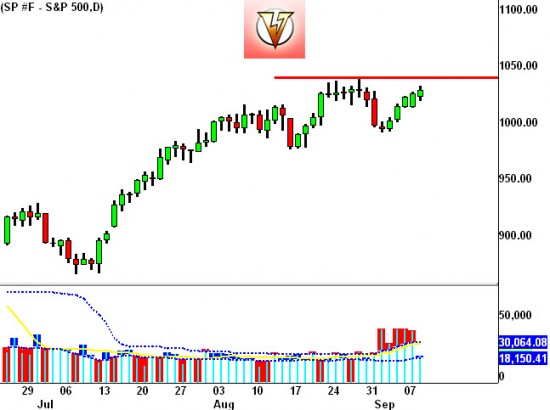
On the daily chart, the market has rebounded from it’s (ever so slight) sell off last week. Over the last four sessions, there has been a relative increase in volume in the pit traded contract. Any time volume veers from it’s average, it is worth noting.

S&P Pit Contract - Daily

S&P Pit Contract - Daily


All eyes are still on gold, which is consolidating after last week’s ascent.

Spot Gold

Spot Gold


I am flying home from Singapore and will be back tomorrow.

And that’s a rap.

Solid Jackie O Gold

Season I, Episode II is live. Before viewing, be sure to turn up the volume.

My mission is timeless. Within it’s timelessness there are cross sections of time.

This cross section takes us back to the 70s. Art is trading and trading is art. My gold trade in the 70s is one of my finest works of art.

jackie-o-gold

September 7, 2009

Cerberus Capital

In 2006 Cerberus Capital Management took a controlling 51 percent stake in lender GMAC from General Motors Corp for $7.4 billion.

In 2007, at the height of the credit bubble, Cerberus bought 80.1% of Chrysler from Daimler. Along with their co-investors, they ultimately invested $7.4 billion in Chrysler—a sum they now value at 1.4 billion, or 19 cents on the dollar.

In the interest of your informed scrutiny, the rundown on Cerberus execs: Former US Treasury Secretary John Snow is chairman; Steve Feinberg is president; and former Vice President Dan Quayle runs one of it’s international units.

In December of last year, Cerberus halted requests for redemptions in two of it’s funds — Cerberus Partners LP and Cerberus International LP — to avert having to sell the funds assets at “fire sale” prices. At the time, they intended to pay 20% of year-end withdrawals in cash and suspend the remaining redemptions for up to 12 months.

Since December, Cerberus has faced a slew of redemption requests from investors. Citing weak market conditions, they have not returned any cash. In an effort to restructure the funds, investors were asked if they’d move their holdings into a new fund that would have longer lock ups, but lower fees.

In response, clients representing a large portion of the funds — as much as 60% or 70% of total assets — have requested to withdraw.

Last week, traders in London and Frankfurt were abuzz with talk of a major hedge fund defaulting. Given recent reports of large redemption requests, speculation quickly turned to Cerberus. On September 1st, spokesman Tim Price stated,

“There is absolutely no truth to the speculation.”

On the same day, the Financial Times reported That COO of Cerberus, Mark Neporent, “stressed that those redemption requests totaled less than 20% of Cerberus’s $24.3bn in assets under management and would not constrain its ability to operate it’s private equity and hedge funds businesses.” Neporent is quoted as saying, “We still have lots and lots of money in our core business. We have ample liquidity to do what we want to do.”

All of this takes me back to the public markets. Warning signs indicate impending stress–especially in the financials. Any rally in equities last week remain unconfirmed by the credit market, where spreads have widened. When I hear the statement, “We have ample liquidity,” I am reminded of so many fallen financial giants whose similar words echoed in their demise.

I can’t help but wonder if Cerberus — or someone else for that matter — is indeed facing a liquidity crisis.

If someone is in danger of default, it is likely due to leverage. Are they over-leveraged? If so, who are the counter-parties to their risk?

Cerberus Capital is named after the Roman mythological three-headed dog that guarded the gates of the underworld–also known as Hades. Ironically, Cerberus Capital, or some other potentially over-leveraged entity, may be a monster of more epic proportions than anyone realizes.

Cerberus


Cerberus

September 6, 2009

Fed President Hoenig Comments

Federal Reserve Bank of Kansas City president Thomas M. Hoenig is out over the wires making some comments. Hoenig is one of the more hawkish (anti-inflation) members of the Fed. Next year, he will rotate in as a voting member of the FOMC.

In recent comments from Jackson Hole, Wyoming, he spoke of the need for the Fed to focus on the right timing for it’s exit strategy.

Today, he speaks to the record amount of debt we are holding, and the huge pressure on the Fed to keep rates low. Speaking to this pressure, he warns:

“As we become more confident that we are at the bottom of the recession and are moving into recovery, we must become more resolute in systematically reducing our balance sheet and raising interest rates.”

Most importantly, Hoenig said large banks are still too highly leveraged and that he expects proposals to force them to raise more capital are:

“Wishful thinking and will not be achieved.”

Leverage is useful when applied at the right time — when the probability of growth is high. When applied at the wrong time or when not reigned in at the right time,  you run the risk of no longer being able to service or restructure the debt–gambler’s ruin.

If large banks are too highly leveraged and proposals to force them to raise more capital cannot be achieved, the risk of gambler’s ruin shifts.

To an inevitability.

September 4, 2009

Market Rap 04 September 2009

Volumes dropped to their lowest levels of the week today on the NYSE and the NASDAQ as traders hit the eject button earlier than normal ahead of the three day weekend in the US.

The S&P futures closed near their highs of the day as well as at the 50% retracement level from the highs of the week. The pit traded S&P showed a pick up in volume that was not seen in the e-mini contract.

S&P Pit Contract - Daily Chart

S&P Pit Contract - Daily Chart


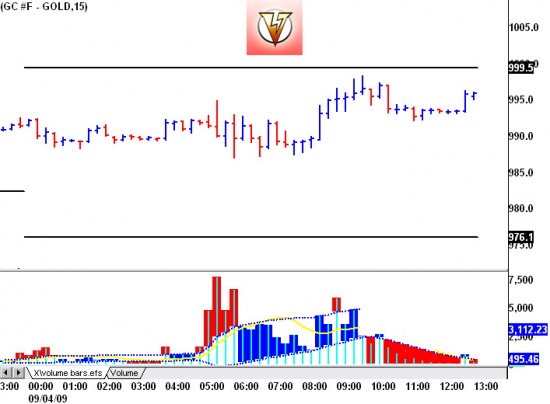
Gold traded within yesterday’s range and closed near the highs (but just below the $1,000 barrier). Traders continue to ponder the move in gold — whether it’s a fake out or breakout.

I spoke to several trading desks today. Not surprisingly, our conversations quickly veered to gold. From what I gathered, because of the sudden interest — be it a squeeze or not — traders are buying gold now and planning to ask questions later — a strategy that has a tendency to bite back hard if things don’t work out as planned.

Fed fund futures are pricing a 1.5% chance (extremely unlikely) of a fed funds rate rise by the December FOMC meeting, which could be the catalyst behind the sudden spike in gold prices. The longer the fed waits to raise rates, the larger the inflation problem will be.

For the time being, I reside in the deflation (versus inflation) camp. If gold does break above $1,000 and holds the line, I’ll buy gold futures faster than I can blink. My deflationary thesis is fundamental. A breakout in gold would be technical. When in doubt, I typically run with the technicals. Further, being long gold against my short equity/short commodity exposure will provide a decent hedge, which is not to imply that I am a fan of running a hedged portfolio.

Gold Futures - 15 Minute

Gold Futures - 15 Minute


Markets are closed in the states Monday, so I am jetting off to China in the next couple of hours to catch the Monday session in Shanghai. If I see anything worth pointing out, you’ll be the first to know.

And that’s a rap.

« Newer PostsOlder Posts »