Around the globe, news from China that Foreign Direct Investment dropped by 35.7% year over year sent Shanghai stocks for a 5.8% elevator ride down. This was the worst FDI number since November.
Japan reported GDP growth, but the number was weaker than expected.
Dax Volatility was up 12.5% as European indices were weaker across the board.
In the states, commodities, equities, precious metals and currencies are all off meaningfully.
Since the March lows, the S&P 500 has rallied roughly 50%. There are two forces that determine market prices: buyers and sellers. In a healthy uptrend, buyers overwhelm sellers, demand far exceeds supply, and prices are propelled higher.
On the flip side, markets can be moved higher without a huge increase in demand. This happens when sellers retreat. In short, the market can be moved higher on weak demand so long as supply is even weaker.
Since the lows, buying has lacked vigor and sellers have all but vanished. These observations have been the primary thrust behind my risk aversion thesis.
In the last couple of weeks, I have observed small improvements in both volume and demand. This change is worth noting as it differs from the behavior seen since March. Notable as this change is, it is only one of many data points. The most important observation in reference to this improvement is follow through. Will volume and demand continue to improve? If the market begins to retrace, will heavy selling emerge? For the time being, traders are finding every reason to increase their risk. At some point, de-risking will replace re-risking, and sellers will overwhelm buyers.
There are a myriad of data points–both technical and fundamental–that lead me to believe the March low was not THE LOW. As mentioned, the rally from the march lows was not a function of vicious buying, rather the result of a retreat in selling.
In the shorter term, there are signs emerging that hint at trouble for equities. Credit spreads are widening and the credit markets have begun selling off. Premiums in default swaps are rising which hints that big players are putting on flight to safety trades. During a conversation with a well-known billionaire this week, he opined that credit markets (as opposed to equities) are beginning to better reflect the fundamentals. The disconnect between credit and equity will not persist indefinitely.
Given the overbought nature of equities off the July lows, it won’t be a surprise to see the market give back some of it’s recent gains. When the market does sell off, it may do so far more substantially than the majority are prepared for. Jesse always used to remind me:
“Stocks are manipulated to the highest point possible and then sold to the public on the way down.”
Where that highest point of manipulation is remains elusive. At some point the inevitable catalyst lower will emerge. Before it does, there will be plenty of clues.
“Notable is also the collapse in M&A deal volume. The facts that companies are unwilling to spend either cash or stock currency in order to grow, should be very indicative to primary equity investors who, despite this graph demonstrating that no companies are even considering expanding in this environment, keep on purchasing follow on offerings in the crappiest of sectors for totally unfathomable reasons.”
“As a result, Russia has become the arbiter of global diamond prices. Its decisions on production and sales will determine the value of diamonds on rings and in jewelry stores for years to come, in one of the most surprising consequences of this recession.”
“The Standard & Poor’s 500 Index’s 28 percent rise since March 9 is a “sucker’s rally,” and the overvalued measure may plunge 62 percent as earnings continue to shrink, according to David Tice of Federated Investors Inc.”
David and I agree. I mention my long term target for the S&P in this comment.
The machines jammed the e-mini futures contract above yesterday’s highs in the evening session last night. The rally soon fizzled when at around 8:30 AM EST this morning the socialized Manhattan bankers arrived at their proprietary (prop) desk trading turrets—the only sources of profits left in what was once known as investment banking.
When prop trading accounts for the bulk (if not the entirety) of ones revenues, how can the corporate charter retain the title Investment Bank? Perhaps it is time to revise such charters to reflect what they really are—socialized hedge funds. Unfortunately, prop trading models work brilliantly, until they don’t. Now that prop trading is broken, the already collectivist banks will become systemically more socialized thanks to the secondaries being sold to the public via the shilling on CNBC.
Case in Point: As I write, Morgan Stanley (MS) is out with a $2 billion dollar secondary offering announcement. Not to be outdone by the competition, Wells Fargo (WFC) had already announced a $6 billion dollar secondary. Scary. But not quite as ominous as the $6 billion Dow Chemical (DOW) debt offering.
But I digress.
Once US investment bank prop traders arrived at their desks, S&P futures sold off all day until the magical last half hour of equities trading. Then the machines (naturally) seized their opportunity to force up the futures a quick 12 points in about 30 minutes. The S&P and the Euro moved in tandem as the chart below illustrates. The Euro did not fluctuate as strongly as the S&P. The e-mini contract is where the wildest action was, as prop desks still live under the delusion that their quantitative models exploit some sort of edge.
S&P 500 (top) Euro (bottom)
The 1PM EST bond auction results sent the bond reeling and out of the range previously mentioned here at Trade the Picture.
Being long Treasury Note calls is my current “outlier” postulation of the year. This trade will work because a) mortgage rates need to stay low and they cannot if Treasuries don’t rally, and b) Treasuries move in tandem with the Volatility Index ($VIX). Restating my restatement: the Fed will squeeze the bond higher to maintain low interest (mortgage) rates, or else market volatility will return and a flight to safety will push the bond higher. Either way, it looks like a win-win for Mr. Volatility.
Other items of note:
The “Upgrade of the Day” award goes to none other than Morgan Stanley (MS) for promoting Bank of America (BAC) and awarding it a $25 price target. Look for some reciprocity in the days to come. Very likely, (BAC) will soon be handing out the promotions—promotions Morgan urgently needs given the fact they have $2 billion of equity to sell to the public.
When news of the (MS) secondary hit the wire I reached for my Bloomberg terminal to see which earthly investment bank would underwrite such an offering. The headline read to the effect of “Morgan Stanley & Co. Incorporated will serve as the sole book-runner for the offering.” Given they are representing themselves, there obviously won’t be a conflict of interest.
Speaking more to the point of secondaries, I’d like to grant a (dis)honorable mention to Jim Cramer who advised viewers that—since he’d potentially like to invest his personal charitable trust into the the ubiquitous secondaries flying all over Wall Street—they too should put their hard earned dollars into such deals. By talking his own book that doesn’t even exist due to trading restrictions, Jim sure has reserved himself a seat in the Wall Street shill hall of fame.
The quote of the day goes to Rick Santelli (see video below) who actually drew a chart on live TV today to explain where current economic policy will lead:
“We are using future revenues to fix the hole today, so we’re going to be carrying a trailer load up a hill for the next several years.”
Rick remains one of the few people on television to whom it is worthwhile listening.
ADP job figures hit the tape at 5:15 EST this morning; within one minute the machines had bid up the e-mini futures contract 10 points. With its surplus time, the market then consolidated most of the day around the prevailing highs.
Meredith Whitney—the recipient of death threats for calling the banks out on their shenanigans long before the mainstream press deigned to comment—spoke out today warning of the bubble in credit card debt that is soon to burst. She was quickly disregarded, as Capital One Financial was bolstered by the stress test results and an upgrade. After the bell, $COF traded even higher based on reports from the Wall Street Journal that they “do not need to bolster their capital.”
Things of note:
The NASDAQ was a clear underperformer today. While the Dow and S$P futures closed above yesterday’s highs, Nasdaq futures fell short.
Despite the strength in the tape, the Philadelphia Housing Sector Index $HGX closed off just over 2 1/4%.
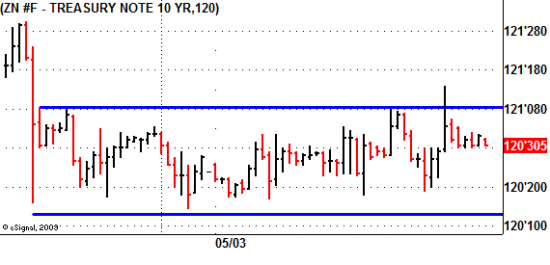
In spite of the weak dollar USD, the Treasury Note ZN_F held firm. It remains in the range I discussed in yesterday’s post.
10 Year Treasury Note
In the trading pits, all eyes have been on Friday. The stress test results are due to be released Thursday after the bell and unemployment numbers are to be released Friday before the open.
The stress test results have been inadvertently (or not inadvertently) leaked to the media—surely Timothy Geithner is applying mascara in preparation for his interview with Charlie Rose as I write. He will not be remiss in reminding us what has already been leaked: banks need an immense amount of capital, but everything is going to be just fine!


 Sunday, April 5, 2026