

Saturday, April 4, 2026

September 4, 2009

Market Rap 04 September 2009

Volumes dropped to their lowest levels of the week today on the NYSE and the NASDAQ as traders hit the eject button earlier than normal ahead of the three day weekend in the US.

The S&P futures closed near their highs of the day as well as at the 50% retracement level from the highs of the week. The pit traded S&P showed a pick up in volume that was not seen in the e-mini contract.

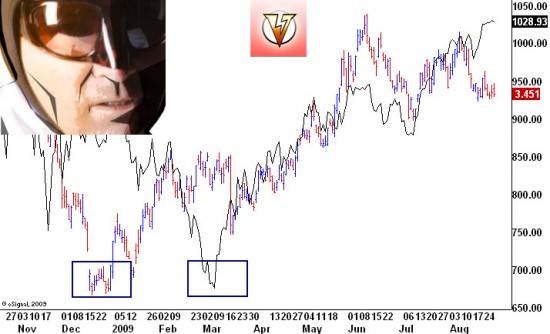
S&P Pit Contract - Daily Chart

S&P Pit Contract - Daily Chart


Gold traded within yesterday’s range and closed near the highs (but just below the $1,000 barrier). Traders continue to ponder the move in gold — whether it’s a fake out or breakout.

I spoke to several trading desks today. Not surprisingly, our conversations quickly veered to gold. From what I gathered, because of the sudden interest — be it a squeeze or not — traders are buying gold now and planning to ask questions later — a strategy that has a tendency to bite back hard if things don’t work out as planned.

Fed fund futures are pricing a 1.5% chance (extremely unlikely) of a fed funds rate rise by the December FOMC meeting, which could be the catalyst behind the sudden spike in gold prices. The longer the fed waits to raise rates, the larger the inflation problem will be.

For the time being, I reside in the deflation (versus inflation) camp. If gold does break above $1,000 and holds the line, I’ll buy gold futures faster than I can blink. My deflationary thesis is fundamental. A breakout in gold would be technical. When in doubt, I typically run with the technicals. Further, being long gold against my short equity/short commodity exposure will provide a decent hedge, which is not to imply that I am a fan of running a hedged portfolio.
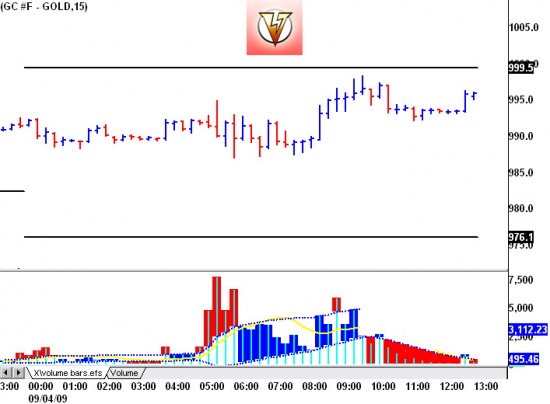
Gold Futures - 15 Minute

Gold Futures - 15 Minute


Markets are closed in the states Monday, so I am jetting off to China in the next couple of hours to catch the Monday session in Shanghai. If I see anything worth pointing out, you’ll be the first to know.

And that’s a rap.
August 30, 2009

Tops In China and Interest Rates

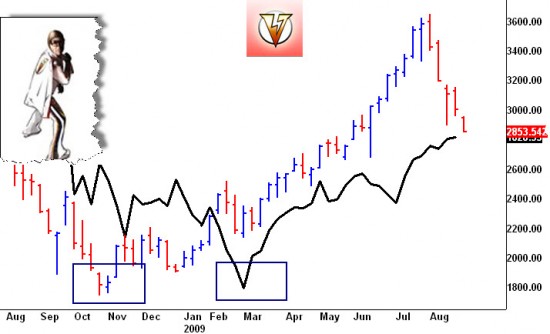
On August 4th, the Shanghai Composite Index printed a high of 3651. It has sold off abruptly since then. So far today, the index is off 5% at 2853. The decline is being led by oil and gas shares as well as basic materials.

China stocks bottomed before US stocks.

Shanghai Composite and S&P 500

Shanghai Composite and S&P 500

Coupled with the Shanghai Composite Index, rates on US bonds also bottomed before US stocks.

Ten Year Rates and S&P 500

Ten Year Rates and S&P 500

Both Shanghai and rates were leading indicators of a bottom in stocks, which begs the question: Is the top in US stocks being signalled by the same things that flagged the bottom?

If risk aversion suddenly becomes en vogue, the exits will be crowded. Buyers have bid up the market in an orderly fashion. Sellers are never as orderly.

Downside insurance remains cheap and undervalued.

May 8, 2009

Thursday 07.May.09 Market Recap

The machines jammed the e-mini futures contract above yesterday’s highs in the evening session last night. The rally soon fizzled when at around 8:30 AM EST this morning the socialized Manhattan bankers arrived at their proprietary (prop) desk trading turrets—the only sources of profits left in what was once known as investment banking.

When prop trading accounts for the bulk (if not the entirety) of ones revenues, how can the corporate charter retain the title Investment Bank? Perhaps it is time to revise such charters to reflect what they really are—socialized hedge funds. Unfortunately, prop trading models work brilliantly, until they don’t. Now that prop trading is broken, the already collectivist banks will become systemically more socialized thanks to the secondaries being sold to the public via the shilling on CNBC.

Case in Point: As I write, Morgan Stanley (MS) is out with a $2 billion dollar secondary offering announcement. Not to be outdone by the competition, Wells Fargo (WFC) had already announced a $6 billion dollar secondary. Scary. But not quite as ominous as the $6 billion Dow Chemical (DOW) debt offering.

But I digress.

Once US investment bank prop traders arrived at their desks, S&P futures sold off all day until the magical last half hour of equities trading. Then the machines (naturally) seized their opportunity to force up the futures a quick 12 points in about 30 minutes. The S&P and the Euro moved in tandem as the chart below illustrates. The Euro did not fluctuate as strongly as the S&P. The e-mini contract is where the wildest action was, as prop desks still live under the delusion that their quantitative models exploit some sort of edge.

S&P 500 (top) Euro (bottom)

S&P 500 (top) Euro (bottom)

The 1PM EST bond auction results sent the bond reeling and out of the range previously mentioned here at Trade the Picture.

Being long Treasury Note calls is my current “outlier” postulation of the year. This trade will work because a) mortgage rates need to stay low and they cannot if Treasuries don’t rally, and b) Treasuries move in tandem with the Volatility Index ($VIX). Restating my restatement: the Fed will squeeze the bond higher to maintain low interest (mortgage) rates, or else market volatility will return and a flight to safety will push the bond higher. Either way, it looks like a win-win for Mr. Volatility.

Other items of note:

The “Upgrade of the Day” award goes to none other than Morgan Stanley (MS) for promoting Bank of America (BAC) and awarding it a $25 price target. Look for some reciprocity in the days to come. Very likely, (BAC) will soon be handing out the promotions—promotions Morgan urgently needs given the fact they have $2 billion of equity to sell to the public.

When news of the (MS) secondary hit the wire I reached for my Bloomberg terminal to see which earthly investment bank would underwrite such an offering. The headline read to the effect of “Morgan Stanley & Co. Incorporated will serve as the sole book-runner for the offering.” Given they are representing themselves, there obviously won’t be a conflict of interest.

Speaking more to the point of secondaries, I’d like to grant a (dis)honorable mention to Jim Cramer who advised viewers that—since he’d potentially like to invest his personal charitable trust into the the ubiquitous secondaries flying all over Wall Street—they too should put their hard earned dollars into such deals. By talking his own book that doesn’t even exist due to trading restrictions, Jim sure has reserved himself a seat in the Wall Street shill hall of fame.

The quote of the day goes to Rick Santelli (see video below) who actually drew a chart on live TV today to explain where current economic policy will lead:

“We are using future revenues to fix the hole today, so we’re going to be carrying a trailer load up a hill for the next several years.”

Rick remains one of the few people on television to whom it is worthwhile listening.

Peace

May 1, 2009

Magazine Files

Shortage Of Short Paper (Zero Hedge)

“All we need now is illiquidity in the bond market to follow the joke that equity liquidity has become to put a cherry on top of this utterly broken market. Either way, this will make it even more fun for the Fed to follow through with its QE [Quantitative Easing] strategy.”

QUESTIONS ABOUT GOLDMAN SACHS’ ROLE IN MARKET (New York Post)

“SOMETHING smells fishy in the market. And the aroma seems to be coming from Goldman Sachs.”

“According to the latest numbers put out by the New York Stock Exchange, Goldman did twice the number of so-called big program trades during the week of April 13.”

Mr. Know-It-All on Conspiracies (Wired)

There’s hope, but your cogent arguments are unlikely to hasten any shift in your brother’s thinking. In fact, your strenuous efforts at dissuasion could end up reinforcing his views.

Peace

April 28, 2009

Rick Santelli Agrees with Mr. Volatility

Back at the office, my traders and I were discussing the bond market, specifically the Ten Year Treasury Note and it’s rate.

I don’t watch CNBC. One of my traders keeps an ear on it for me. He alerted me to the rumor Rick Santelli spoke of today: The Treasury would start to sell a 50 year bond. Rick Santelli is one of the only people on CNBC worth listening to. After all, who else on that channel has been in and around the trading pits since 1979?

In my post from April 22nd, I laid out my thesis on how the Ten year will be moved higher. I said that the FED would halt sales of the 30 year, exactly as they did in the year 2001. This action would then spike demand for the Ten Year. If US bonds are a safe haven, and you cannot buy 30 year US bonds, the safe haven becomes the Ten year.

Rick and I agree. The Ten Year goes higher. Rick thinks they’ll halt the 30 Year and offer a 50 year. I think this is possible. One thing that gives me pause is how embarrassing the UK’s offering of 40 year gilts (bonds) was in March. I don’t think it would look too good for the FED to offer a 50 year to a tepid response.

Whether they offer a 50 year or not, I don’t know. I do know that rates must go lower. Markets don’t move, they are moved. As the FED moves the Ten Year to new highs, the rate will move to new lows.

Below is a chart of the Ten year and the rate on the Ten Year. Notice the inverse movement. Notice the red line at the bottom. Rates will go below there. They have no choice. The mathematics are irrefutable.

Inverse

Inverse

Peace

« Newer PostsOlder Posts »