Meanwhile, back at the office, Pinky Megiston–who I am rumored to have a romantic relationship with and who is my client in that she pays me for P.I. (private investigator) services rendered–is having lunch with my assistant, Tonya. The waitress that is serving them is one of my best undercover agents. She will recap their entire conversation with me later. Before I meet with Tonya for drinks, I am speaking with my team of traders and we are re-capping the week that was on Wall Street.
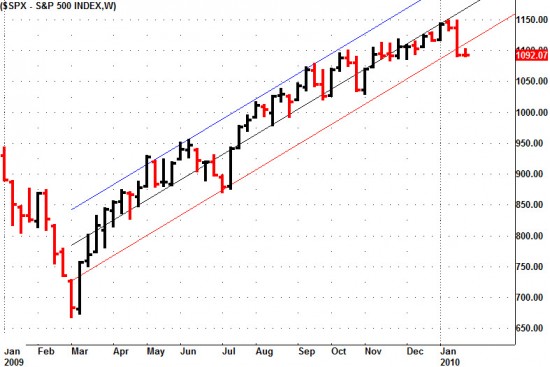
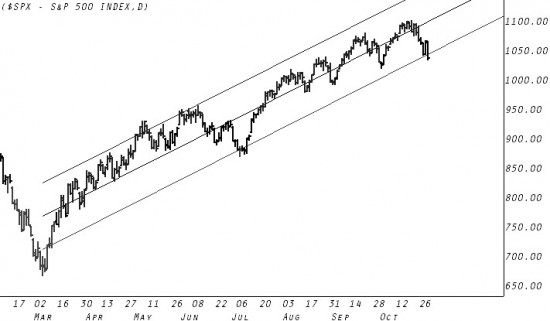
The stock market continued it’s low volume ascent and the S&P 500 closed higher by 4.5% on the week at 1071.49. Friday saw volume in the SPY the lowest it has been in 2009. Anemic as volume has been since the March lows, buyers have clearly defeated sellers. When the ascent will end is anyone’s guess. Clearly the technicals are disconnected from the fundamentals, a scenario that presents enormous opportunities for traders such as myself.

S&P 500 - Daily

S&P 500 - Weekly
Markets, like all complex systems, consist of agents and networks of agents–some rational and some not. Disconnects in markets occur when the majority have the same opinion all at once. A classic example of such a disconnect was seen in the price of Research In Motion (RIMM) post earnings September 24th.
The majority of the time, markets are topsy-turvy and chaotic in that buyers and sellers are in disagreement. The disagreements–based on opinion, timeframe of trades, size of orders, etc.–tend to balance each other out. When there is a disconnect–like there is now between the technicals and the fundamentals–the disagreement between agents is orderly and balanced. At some point–usually due to some catalyst–the orderly, balanced disagreement of market agents suddenly shifts to a consensus. It is at these junctures of consensus, where suddenly all agents on all timeframes share the same opinion, that the outlier gains are attained. If I am not in front of these gains, my mission becomes sidetracked–a scenario in which I am not in favor. I continue to monitor a myriad of markets for signs of an impending consensus. If I am positioned appropriately, my track record will be further bolstered–and my opinion will be in higher demand.
The Dollar
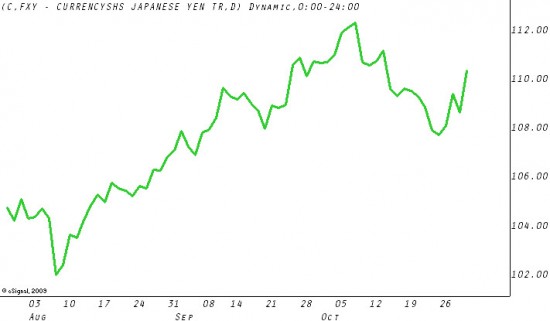
The US Dollar Index (USD) hit a new year low on Thursday last week, but strengthened on Friday. If the dollar is to catch a sudden bid, the ramifications for all dollar denominated assets will be vast. One of the most reliable quant trades this year (outlined here 15 Sept.) is gunning the Euro Yen cross higher, forcing the dollar lower, and equities higher. Lately, it is taking more and more buying in the EURJPY for the same incremental gain in equities. When this trade breaks down is unknown. However, my quant pals at Goldman tell me it may not last much longer. Regardless, the dollar holds an important key to the market puzzle. There are very few dollar bulls out there. The market has a way of tricking the majority. This time will be no different.
There were some large, loud rumors last week that a consensus is building to re-denominate oil away from the US dollar. The likelihood of this happening is very remote. Even if the dollar continues to decline, what oil rich nation or oil trader would want to be paid in anything else? Oil is the most traded commodity on the planet. Large traders want to settle in the currency with the most liquidity. Any story to the contrary is nothing but politics.
Treasuries
The Treasury market saw selling Thursday upon the release of the $12 billion 30-year bond auction. The bid to cover came in at 2.37 compared to 2.97 in September. Selling in Treasuries exacerbated on Friday due to confusion over the multi message FED heads sending mixed signals on the timing of their tightening and the mystery surrounding the true level of hawkishness amongst FED members.
It is my opinion that the move lower in Treasuries is not the result of elevated inflation expectations. To date, there is still very little, if any, evidence of inflation. Deflation remains the issue, in spite of what the headlines read. The poor 30-year results were the initial catalyst for the selling. Overnight rumors of large dealer liquidations and a bond market holiday Monday all caused the move lower to be exaggerated.
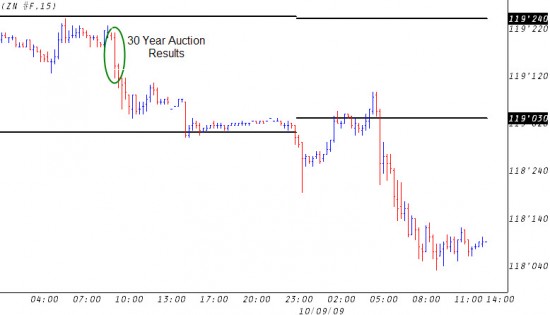
Ten Year Futures - 15 Minute Chart
Corporate Bonds
The weakness in the treasury market points to portfolio managers adding risk exposure (equities as opposed to US bonds) last week. However, the corporate bond market told a different story. Generally thought of as a more important tell as to the pricing of risk, corporate bonds sat out the equity rally last week. With equities higher, volatility and treasuries lower (rates higher), the consensus seems to be that adding risk (as opposed to mitigating it) into year end is the money trade. Not so fast says the corporate bond market, which continues to price in more risk than do stocks. If the corporate market continues to underperform equities–as it did last week–the risk of a significant decline in stocks is amplified. The iShares Investment Grade Bond Fund ETF (LQD) when paired against the Spyders (SPY) exhibits the disagreement between the two markets. This disagreement will likely lead to a disconnect in price. It is not a matter of if, but when.

SPY / LQD - Daily Chart
Gold
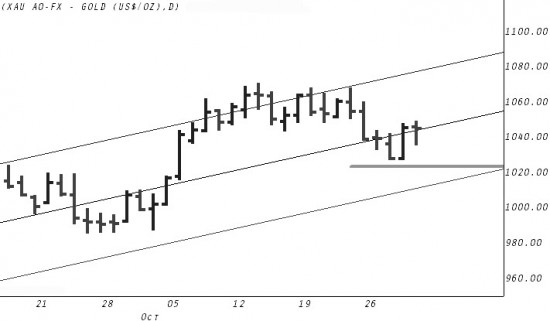
After four weeks of consolidation, gold took the path of least resistance higher this week. Spot gold closed at $1,048.25. From a pure technical standpoint, the chart of gold conveys that the inflation trade is on. I cannot argue with the strength of the technicals or the breakout to an all time high. It is the fundamentals–a deflationary environment–that have me cautious on gold. That said, I continue to keep an eye on the yellow metal for possible entries, either long or short.
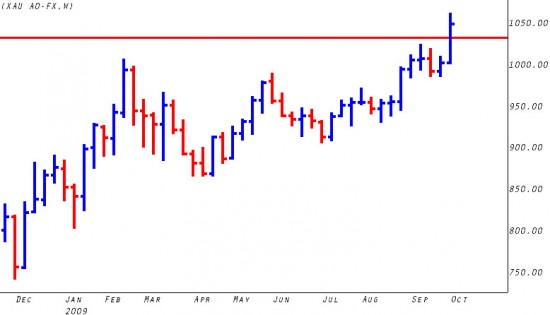
Spot Gold - Weekly
Earnings
Earnings season kicks off next week. Some names of interest are INTC, LLTC, XLNX, IBM, AMD, GOOG, and NOK. Alcoa (AA) reported the ninth consecutive quarter of year/year sales declines last week. Across the board, it is doubtful that earnings will be substantially higher than last year. The reaction to the earnings will be more important than the earnings themselves. If traders focus on sales beating already ratcheted lower expectations, than equities could continue their upward ascent. However, if traders focus on the fact that sales and earnings are declining–independent of analysts and their beat the lowered expectations games–then we may just see equity prices begin to correct.
Whatever scenario plays out on whatever timeframe, the beat goes on.


 Saturday, April 4, 2026