Saturday, April 4, 2026

February 16, 2010

Sovereign Outlier Triangulation

As the previously documented sovereign event approaches, the uncertainty that remains draws me closer to the prosperity that will effect the collective consciousness of my readership connection. To further dissect the economic scenario that is playing out, I will offer some thoughts on where things are, what could cause things to reverse, as well as how to best prosper from the sovereign contagion that is spreading like wildfire.

Greece

In my prior post, I outlined the sovereign default risk that we face—somewhere, sometime soon. Several geographies are flashing extremely risky scenarios. Greece is in need of a bailout and they lay on the precipice of disaster if some aid is not found. Any proposal of aid I have seen will not be a solution, rather a band-aid on a broken bone. However, a band-aid could buy Greece some time–which they are in dire need of.

Ireland

Economic woes in Ireland are severe, and they are not being given the focus they require. Further trouble in the place where I kissed the Blarney Stone could be the impetus for the contagion to spread further, causing the market dislocation that I anticipate.

Dubai

Risk in Dubai is priced where it was at the height of 2009. Further trouble and inability to restructure will cause fallout in Dubai—which will affect Europe, which will effect Greece, and the dominoes will continue to tip. Last week in Dubai, I found money dealers paying extremely large mark-ups for physical gold. Indeed, rumors of gold being used as legal tender in Dubai are true. Again we see my thesis substantiated: the risk aversion trade here is not the US Dollar, rather the precious metals–gold and silver.

Spain: The Wild Card

All of the above geographies could stabilize, or with further troubles, could act as catalysts for the contagion to spread quicker than it already is.

I’d note that Spain was a large driver of contagion over the past two years. The housing bubble in Spain was by far the largest real estate bubble compared to anywhere else. They also face a severely high unemployment rate. However, even with all this trouble, spreads on banks in Spain are not showing the stress they should. When the stress of the housing bubble and unemployment rate percolates into Spanish banks, it will be easy for Spain to pick up where it left off. More in need of a bailout this time, Spain will contribute to the strain in Europe, affecting Greece, affecting Ireland…tip, tip, tip.

All That Glitters

Though the catalyst remains uncertain, the looming event is undeniable. Remember, when the entire universe lunges to take risk off the table in a reaction to what I anticipate, gold will stand, glittering amidst the debris. I’ve said it once and I’ll say it again: if you don’t own gold, you should.

And the beat goes on.

February 4, 2010

Sovereign Risk Ignites

Meanwhile, as the world turns, so does the Factory and it’s cast of characters. X is monitoring world events; The Consigliere continues to build his law firm specializing in the law of attraction; Pinky Megiston is beautiful; and Anything Anywhere! seeks more avenues through which he can add value.

Apart from all that, sovereign risk spreads are igniting. The dollar is catching a flight to safety bid and stocks are crushing lower–the S&P 500 is off about 2.5% as I write. Gold and silver have been pummeled most severely, off 4% and 5.5% respectively.

Sovereign risk spreads have risen dramatically this week, led by the European majors. Holders of sovereign debt—in particular Portugal, Italy, Ireland, Greece, and Spain—are running for cover. Not surprisingly, politicians will blame these events on speculators. However, a closer look at the money flows reveals true fear: real money is fleeing sovereign debt (selling government bonds) as opposed to speculators driving risk higher by buying credit default swaps (insurance). Nations with the largest deficits and the most in need of short term financing are being sold the hardest.

Dubai has continued to see risk premiums rise, as it scrambles unsuccessfully to sell off some of it’s holdings. Like a skydiver free-falling through the air, Dubai is reaching for it’s reserve chute. The velocity is building to the perilous downside. Hope is not a viable strategy here and now; but other than bluff, it may be all they have.

The crash of 2009 was not foiled—it was postponed.

We are sitting on the precipice of something special. An event where fortunes will be made and lost. Great art will be inspired, and an ageless tale will be re-told.

And the beat goes on.

October 11, 2009

Weekly Market Rap 10.October.2009

Meanwhile, back at the office, Pinky Megiston–who I am rumored to have a romantic relationship with and who is my client in that she pays me for P.I. (private investigator) services rendered–is having lunch with my assistant, Tonya. The waitress that is serving them is one of my best undercover agents. She will recap their entire conversation with me later. Before I meet with Tonya for drinks, I am speaking with my team of traders and we are re-capping the week that was on Wall Street.

The stock market continued it’s low volume ascent and the S&P 500 closed higher by 4.5% on the week at 1071.49. Friday saw volume in the SPY the lowest it has been in 2009. Anemic as volume has been since the March lows, buyers have clearly defeated sellers. When the ascent will end is anyone’s guess. Clearly the technicals are disconnected from the fundamentals, a scenario that presents enormous opportunities for traders such as myself.

S&P 500 - Daily

S&P 500 - Daily

S&P 500 - Weekly

S&P 500 - Weekly

Markets, like all complex systems, consist of agents and networks of agents–some rational and some not. Disconnects in markets occur when the majority have the same opinion all at once. A classic example of such a disconnect was seen in the price of Research In Motion (RIMM) post earnings September 24th.

The majority of the time, markets are topsy-turvy and chaotic in that buyers and sellers are in disagreement. The disagreements–based on opinion, timeframe of trades, size of orders, etc.–tend to balance each other out. When there is a disconnect–like there is now between the technicals and the fundamentals–the disagreement between agents is orderly and balanced. At some point–usually due to some catalyst–the orderly, balanced disagreement of market agents suddenly shifts to a consensus. It is at these junctures of consensus, where suddenly all agents on all timeframes share the same opinion, that the outlier gains are attained. If I am not in front of these gains, my mission becomes sidetracked–a scenario in which I am not in favor. I continue to monitor a myriad of markets for signs of an impending consensus. If I am positioned appropriately, my track record will be further bolstered–and my opinion will be in higher demand.

The Dollar

The US Dollar Index (USD) hit a new year low on Thursday last week, but strengthened on Friday. If the dollar is to catch a sudden bid, the ramifications for all dollar denominated assets will be vast. One of the most reliable quant trades this year (outlined here 15 Sept.) is gunning the Euro Yen cross higher, forcing the dollar lower, and equities higher. Lately, it is taking more and more buying in the EURJPY for the same incremental gain in equities. When this trade breaks down is unknown. However, my quant pals at Goldman tell me it may not last much longer. Regardless, the dollar holds an important key to the market puzzle. There are very few dollar bulls out there. The market has a way of tricking the majority. This time will be no different.

There were some large, loud rumors last week that a consensus is building to re-denominate oil away from the US dollar. The likelihood of this happening is very remote. Even if the dollar continues to decline, what oil rich nation or oil trader would want to be paid in anything else? Oil is the most traded commodity on the planet. Large traders want to settle in the currency with the most liquidity. Any story to the contrary is nothing but politics.

Treasuries

The Treasury market saw selling Thursday upon the release of the $12 billion 30-year bond auction. The bid to cover came in at 2.37 compared to 2.97 in September. Selling in Treasuries exacerbated on Friday due to confusion over the multi message FED heads sending mixed signals on the timing of their tightening and the mystery surrounding the true level of hawkishness amongst FED members.

It is my opinion that the move lower in Treasuries is not the result of elevated inflation expectations. To date, there is still very little, if any, evidence of inflation. Deflation remains the issue, in spite of what the headlines read. The poor 30-year results were the initial catalyst for the selling. Overnight rumors of large dealer liquidations and a bond market holiday Monday all caused the move lower to be exaggerated.
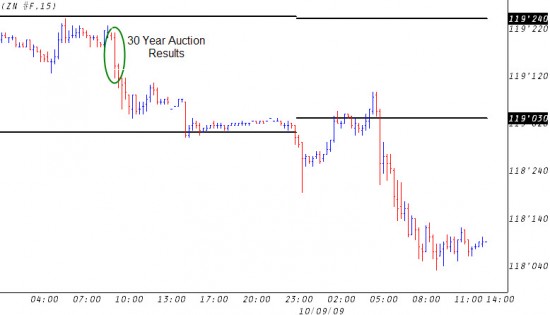
Ten Year Futures - 15 Minute Chart

Ten Year Futures - 15 Minute Chart

Corporate Bonds

The weakness in the treasury market points to portfolio managers adding risk exposure (equities as opposed to US bonds) last week. However, the corporate bond market told a different story. Generally thought of as a more important tell as to the pricing of risk, corporate bonds sat out the equity rally last week. With equities higher, volatility and treasuries lower (rates higher), the consensus seems to be that adding risk (as opposed to mitigating it) into year end is the money trade. Not so fast says the corporate bond market, which continues to price in more risk than do stocks. If the corporate market continues to underperform equities–as it did last week–the risk of a significant decline in stocks is amplified. The iShares Investment Grade Bond Fund ETF (LQD) when paired against the Spyders (SPY) exhibits the disagreement between the two markets. This disagreement will likely lead to a disconnect in price. It is not a matter of if, but when.

SPY / LQD - Daily Chart

SPY / LQD - Daily Chart

Gold

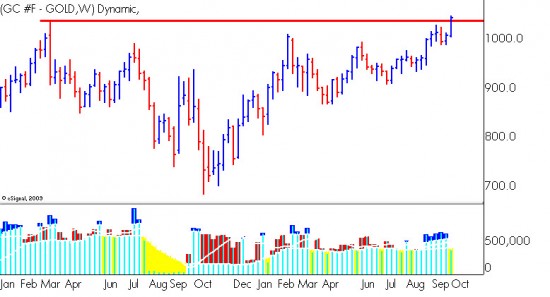
After four weeks of consolidation, gold took the path of least resistance higher this week. Spot gold closed at $1,048.25. From a pure technical standpoint, the chart of gold conveys that the inflation trade is on. I cannot argue with the strength of the technicals or the breakout to an all time high. It is the fundamentals–a deflationary environment–that have me cautious on gold. That said, I continue to keep an eye on the yellow metal for possible entries, either long or short.
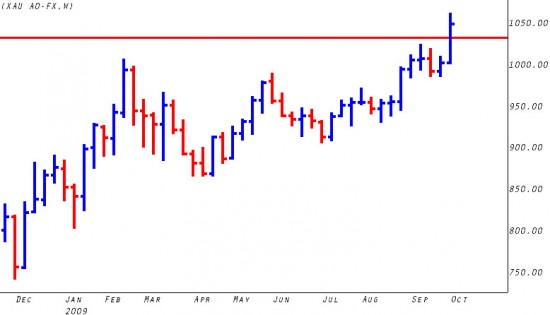
Spot Gold - Weekly

Spot Gold - Weekly

Earnings

Earnings season kicks off next week. Some names of interest are INTC, LLTC, XLNX, IBM, AMD, GOOG, and NOK. Alcoa (AA) reported the ninth consecutive quarter of year/year sales declines last week. Across the board, it is doubtful that earnings will be substantially higher than last year. The reaction to the earnings will be more important than the earnings themselves. If traders focus on sales beating already ratcheted lower expectations, than equities could continue their upward ascent. However, if traders focus on the fact that sales and earnings are declining–independent of analysts and their beat the lowered expectations games–then we may just see equity prices begin to correct.

Whatever scenario plays out on whatever timeframe, the beat goes on.

October 7, 2009

Market Rap 06.October.2009

Meanwhile, back at the office, Gold hit an all time high today and the S&P 500 closed +14.26 points or 1.37% at 1054.72.

The gold market is going to offer an obscene amount of trading opportunities, both long and short, in the years to come. The breakout today is big news.

Gold - Weekly Chart

Gold - Weekly Chart


Now, the big bad question is what to do from here. It has been my viewpoint that gold is vulnerable to a violent sell off–if there is a sudden risk aversion rotation into the US Dollar. Last night, there were rumors that oil traders would abandon the US dollar and attempt to denominate oil against a basket of currencies. These rumors make the rounds now and again, and they are always funny. Oil is not going to trade against anything else anytime soon. After all, if you were an oil trader, what would you like the contracts settled in? I prefer my oil settlements in dollars (just fine thanks). That said, not everyone thinks like I do. The rumors of oil re-denomination, a 25 bps rate hike in Australia and weakness in the greenback all pointed to the the new high in gold today.

I remain sidelined in the yellow metal for the moment, and it feels lonely. The move in gold is starting to be about momentum and trading the technicals–an endeavor which I have a decent track record.

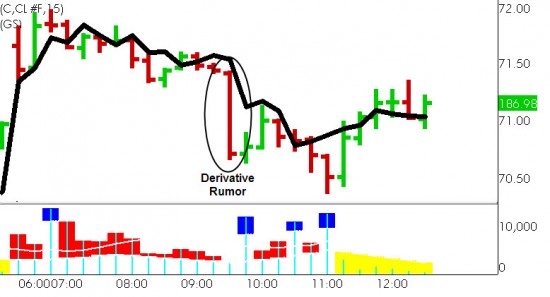
The next chart speaks to the conspiracy theory of the day. Rumors of a derivative loss at Goldman Sachs (GS) between 9:30 and 10:00 AM PST. These rumors come up from time to time. I discussed my thoughts on Goldie in a prior post. I’ll leave them at that. Before you dismiss the Goldman oil rumors straight away, check out the price action. They traded in lockstep throughout the equity session. Conspiratorial as these rumors may be, the charts sure move together.

Goldman Sachs Vs. Oil

Goldman Sachs Vs. Oil


After the bell today, a slew of oil numbers were released. They all seemed inline except the distillate numbers, which were -2.9 million versus a flat estimate. Oil traded a tad firmer on the news.

Tomorrow before the bell we’ll see numbers out of Monsanto (MON) and Costco (COST). After the bell Alcoa (AA).

I am off to dinner with a vice cop turned lawyer turned trader. Reinvention is the mother of innovation. And the beat goes on.

September 23, 2009

Market Rap 23 September 2009


The cash S&P 500 index closed lower by 1% or -10.79 points. The highlighted line in the chart below is the 15 minutes between 2:15 and 2:30 EST; The time of the fed announcement.

S&P Futures - 15 Minute

S&P Futures - 15 Minute

Initially the market traded higher, but the move was faded by the smart money. By 2:45 EST the market was on it’s way lower and sold off until the final 15 minutes.

Rates were expected to remain on hold at 25 bps and as widely expected the fed did not move the funds rate. There has been talk of the fed starting to reign in some of their easy money stance, and it was confirmed that the spigot will be tightened a bit. MBS purchases by the NY Fed will be smaller and not as frequent.

From what I could tell, the S&P traded lower on strength in the dollar. I continue to think a move higher in the USD will catch the majority off guard. If this happens, I am positioned to benefit.

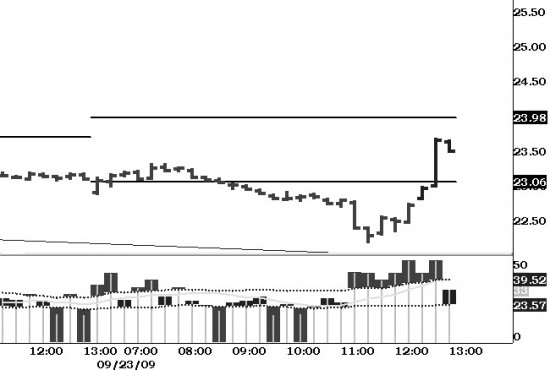
As the dollar gained strength, and the S&P traded lower and the $VIX strengthened. In credit spreads, high yield and investment grade both closed at their respective wides of the day.

Volatility Index - VIX - 15 Minute

Volatility Index - VIX - 15 Minute

The intensity of the selling picked up today on the NYSE. Down volume was just about 76% of the total up/down volume.

I’ll be back at 9:30 AM EST or 6:30 AM PST.

Wherever I am, I will be there. And the beat will go on.

Older Posts »