The Financial Times reports on yet another clandestine form of support the FED gives to banks. What better way to enhance profits at banks then to allow the banks to sell assets to the FED at inflated prices?
“In the interests of transparency, it (the FED) often announces its intention to buy particular securities in advance. A former Fed official said this strategy enables banks to sell these securities to the Fed at an inflated price.”
Rigged markets lead to disconnects. This time will be no different.
The machines jammed the e-mini futures contract above yesterday’s highs in the evening session last night. The rally soon fizzled when at around 8:30 AM EST this morning the socialized Manhattan bankers arrived at their proprietary (prop) desk trading turrets—the only sources of profits left in what was once known as investment banking.
When prop trading accounts for the bulk (if not the entirety) of ones revenues, how can the corporate charter retain the title Investment Bank? Perhaps it is time to revise such charters to reflect what they really are—socialized hedge funds. Unfortunately, prop trading models work brilliantly, until they don’t. Now that prop trading is broken, the already collectivist banks will become systemically more socialized thanks to the secondaries being sold to the public via the shilling on CNBC.
Case in Point: As I write, Morgan Stanley (MS) is out with a $2 billion dollar secondary offering announcement. Not to be outdone by the competition, Wells Fargo (WFC) had already announced a $6 billion dollar secondary. Scary. But not quite as ominous as the $6 billion Dow Chemical (DOW) debt offering.
But I digress.
Once US investment bank prop traders arrived at their desks, S&P futures sold off all day until the magical last half hour of equities trading. Then the machines (naturally) seized their opportunity to force up the futures a quick 12 points in about 30 minutes. The S&P and the Euro moved in tandem as the chart below illustrates. The Euro did not fluctuate as strongly as the S&P. The e-mini contract is where the wildest action was, as prop desks still live under the delusion that their quantitative models exploit some sort of edge.
S&P 500 (top) Euro (bottom)
The 1PM EST bond auction results sent the bond reeling and out of the range previously mentioned here at Trade the Picture.
Being long Treasury Note calls is my current “outlier” postulation of the year. This trade will work because a) mortgage rates need to stay low and they cannot if Treasuries don’t rally, and b) Treasuries move in tandem with the Volatility Index ($VIX). Restating my restatement: the Fed will squeeze the bond higher to maintain low interest (mortgage) rates, or else market volatility will return and a flight to safety will push the bond higher. Either way, it looks like a win-win for Mr. Volatility.
Other items of note:
The “Upgrade of the Day” award goes to none other than Morgan Stanley (MS) for promoting Bank of America (BAC) and awarding it a $25 price target. Look for some reciprocity in the days to come. Very likely, (BAC) will soon be handing out the promotions—promotions Morgan urgently needs given the fact they have $2 billion of equity to sell to the public.
When news of the (MS) secondary hit the wire I reached for my Bloomberg terminal to see which earthly investment bank would underwrite such an offering. The headline read to the effect of “Morgan Stanley & Co. Incorporated will serve as the sole book-runner for the offering.” Given they are representing themselves, there obviously won’t be a conflict of interest.
Speaking more to the point of secondaries, I’d like to grant a (dis)honorable mention to Jim Cramer who advised viewers that—since he’d potentially like to invest his personal charitable trust into the the ubiquitous secondaries flying all over Wall Street—they too should put their hard earned dollars into such deals. By talking his own book that doesn’t even exist due to trading restrictions, Jim sure has reserved himself a seat in the Wall Street shill hall of fame.
The quote of the day goes to Rick Santelli (see video below) who actually drew a chart on live TV today to explain where current economic policy will lead:
“We are using future revenues to fix the hole today, so we’re going to be carrying a trailer load up a hill for the next several years.”
Rick remains one of the few people on television to whom it is worthwhile listening.
ADP job figures hit the tape at 5:15 EST this morning; within one minute the machines had bid up the e-mini futures contract 10 points. With its surplus time, the market then consolidated most of the day around the prevailing highs.
Meredith Whitney—the recipient of death threats for calling the banks out on their shenanigans long before the mainstream press deigned to comment—spoke out today warning of the bubble in credit card debt that is soon to burst. She was quickly disregarded, as Capital One Financial was bolstered by the stress test results and an upgrade. After the bell, $COF traded even higher based on reports from the Wall Street Journal that they “do not need to bolster their capital.”
Things of note:
The NASDAQ was a clear underperformer today. While the Dow and S$P futures closed above yesterday’s highs, Nasdaq futures fell short.
Despite the strength in the tape, the Philadelphia Housing Sector Index $HGX closed off just over 2 1/4%.
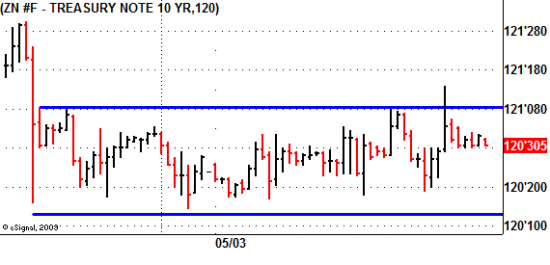
In spite of the weak dollar USD, the Treasury Note ZN_F held firm. It remains in the range I discussed in yesterday’s post.
10 Year Treasury Note
In the trading pits, all eyes have been on Friday. The stress test results are due to be released Thursday after the bell and unemployment numbers are to be released Friday before the open.
The stress test results have been inadvertently (or not inadvertently) leaked to the media—surely Timothy Geithner is applying mascara in preparation for his interview with Charlie Rose as I write. He will not be remiss in reminding us what has already been leaked: banks need an immense amount of capital, but everything is going to be just fine!
The S&P 500 traded in a narrow 10 point range today. The pit was very quiet. As previously chronicled here, the big money has been ominously quiet during this equity run up.
The bond has been trading in a narrow range of late. However, it is trading at the high end of that range as I write.
ZN_F 120 Minute Chart
The much talked about news this evening is the fact that Bank of America $BAC needs $34 billion in capital
Given this news, The bond is higher and equity futures are lower. What was already abundantly clear has now been officially leaked and a spokesperson from $BAC has declined comment. $BAC sealed their fate when they bought Merrill. Once Gambler’s ruin has ensued, there is no escape. The mathematics of leverage prevent it.
“In a significant shift, White House and Treasury Department officials now say they can stretch what is left of the $700 billion financial bailout fund further than they had expected a few months ago, simply by converting the government’s existing loans to the nation’s 19 biggest banks into common stock.
Converting those loans to common shares would turn the federal aid into available capital for a bank — and give the government a large ownership stake in return.
While the option appears to be a quick and easy way to avoid a confrontation with Congressional leaders wary of putting more money into the banks, some critics would consider it a back door to nationalization, since the government could become the largest shareholder in several banks…
Taxpayers would also be taking on more risk, because there is no way to know what the common shares might be worth when it comes time for the government to sell them.”
To avoid having to beg for more money while being broadcast on national television, the government is carefully crafting a shift in the bailout plan. They will “stretch dollars” so that even more bank risk can be shifted to the masses. This sub plot is so obvious it cannot even be classified as “slight of hand.” There is one great trick inherent in this plan however—now you see a capitalist free market, now you don’t! With each and every new governmental “ownership stake” in private business, we creep ever closer to a socialist economy. The best ruse: they pulled the coin right out from behind our own ears!
With bailout dollars now convertible into equity, more dollars will magically appear—they have “stretched.” The pile of money is now bigger! But ask yourself, how much is a stretchy dollar worth?
The Catch
The catch is obvious: dilution. Now, the government will own a bigger share of the equity in the bank, but the equity will be diluted. This has significant ramifications for the masses. Recall when the article said, “taxpayers would also be taking on more risk.”
You are the government. Nationalized losses are your losses.
Gains for a few, losses for the masses.
Nothing changes in the markets—just the participants.


 Sunday, April 5, 2026