Saturday, April 4, 2026

September 25, 2009

Market Rap 25 September 2009

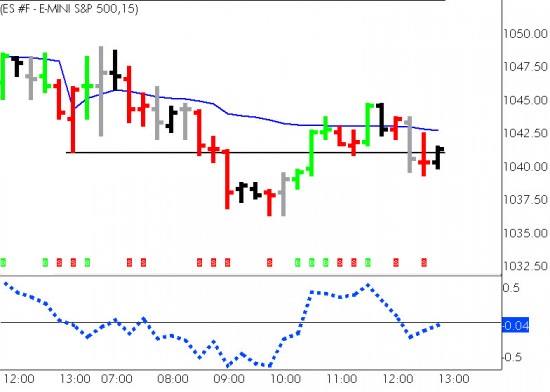
The S&P cash index closed lower by 6.40 points or .61% at 1044.38. The S&P mini futures contract closed at 1041.00 — 4.75 points off it’s low print of 1036.25, which was printed just after 10AM PST.

ES - 15 Minute

ES - 15 Minute

Overnight, credit spreads in Asia were wider by 9% on bearish news out of Aiful as well as a 30% dilutive secondary offering out of Nomura Holdings (8604.TSE). In the states, credit spreads were wider across the board. Default swaps were active with about 7 wideners to every tightener.

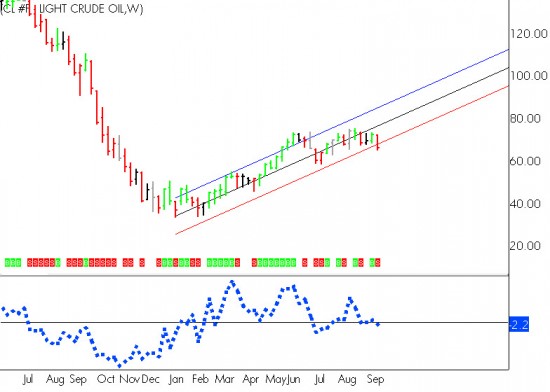
Gold came into the week at $1,006.15/oz. and closed slightly lower at $991.35/oz. Crude oil closed a tad higher today, but lower on the week to settle at $65.05. Crude has broken lower out of consolidation in what could be a harbinger of further weakness in the near term.

Crude Oil - Weekly

Crude Oil - Weekly

Research In Motion closed lower by 17% at $68.91, just above it’s low print of $68.47.
The $VIX closed at 25.61, up 2.65% on the day.

I’d sum up this week’s trade in equities as mildly distributive. I saw evidence of defensive posturing (risk aversion) amongst traders. In order for the sell-off to gain momentum, we will need a catalyst. What that catalyst could be is yet to be known. The situation will continue to be monitored and the beat will go on.

September 16, 2009

Mid Day Update

The beat goes on mid day in New York.


The S&P 500 is up 11.86 points, the DOW up 79.65 and the NASDAQ Composite up 21.35 at about 1:15 EST.


Steve Liesman reported earlier that commercial real estate exposure at large regional banks is undergoing major review by the Fed. Further, the Fed has yet to decide whether or not to do full stress tests.

The bank “stress tests” earlier this year were rigged. REITs have raised a tremendous amount of cash through equity and debt offerings in the past 6 months. Unfortunately, the leverage in the sector was immense, and the repair is just getting started — in spite of whatever public relations stress tests are administered.


Last evening, Polish central banker Stawomir Skrzypek was over the wire saying the financial crisis is entering a new phase and that asset sales cannot be the only method to amend the budget. In other words — we can’t just sell things, we need to cut spending. Sage advice. Perhaps central bankers around the world will take note. I am keeping an eye on Poland for several reasons. First, they are extremely vulnerable to credit risk. Second, there was a failed government bond auction last week — only half of the five year notes offered by the finance ministry were purchased. In reaction, analysts recommended selling Polish bonds across the curve. Last week, Polish central banker Dariusz Filar stated that Poland’s 2010 budget assumptions are appropriate, and he believes 2014 is a realistic date for Poland to adopt the Euro. Talks of a currency crisis have begun to make the rounds. The Polish Zloty is certainly vulnerable.


The National Banking League (NBL) received coverage in analyst land last evening. Analysts at BofA/Merrill see sales of Citigroup (C) shares by the government as having little dilution and maintain their buy rating.

“It is highly unlikely that the government would exit it’s position in Citigroup (C) in a disorderly fashion. Common shares will be disposed of through secondary offerings of large blocks of shares to institutional investors.”

“7.7 billion shares should be considered in the context of recent daily trading volumes of 1 billion shares per day.”

As BofA/Merrill competes for the banking fees to run the (C) secondary, there isn’t possibly any conflict of interest in these analyst comments. Are there?

Market Rap 15 September 2009

Meanwhile, back at the office, I am consulting with one of the most important people in my network, X. We are talking about a few different ways that quant traders at Goldman Sachs are making money right now. The number one trade over at the trader’s pit of government workers — Goldman — is gunning the S&P higher by going long the euro yen spread against the dollar. Thanks to the overweight of euros to yen in the dollar index, as you buy EURJPY with dollars, the dollar is pushed lower, and the S&P higher. As soon as this structure is in place, you lever long S&Ps.

These are the trades that are making Goldman’s trading stats so good right here and now — a tremendous record to say the least. I know tons of traders over at Goldie, and we speak on a regular basis. Some of them are my very good friends. Speaking to one of them the other night, I said, “Your track record is really good.” If nothing else, good trader’s know that the tape can be very humbling. He agreed.

Sometimes when trading records are too good — like with Enron — no one asks the right questions until it is too late. Whatever happens, I hope my trader pals at Goldie will be all right.

After that, we recapped today’s scores.

The S&P 500 is up 16.5% YTD and was up 3.29 points or .31% today.

The move higher in gold continued. The only bearish thing I can ask about gold is this: if the price index numbers released today were more inflationary than expected, why was gold not up even more? Other than that, it seems like the move in gold is holding and strengthening. One miner of note — Newmount (NEM) — sold bonds in exchange for $2 billion dollars ($900 million senior notes 5.125% due 2019 and $1.1 billion of 6.250% due 2039). The raise was 8.7% of the companies market cap. The smartest traders of gold are likely the miners themselves. It is notable that more than one of them is raising cash — through one mechanism or another.

If you are watching the scores all day, be sure that the symbols of the big five (Citigroup, AIG, Citi, Fannie and Freddie) are on your screen. Those five are making up 30% of the volume in today’s exchange of cash for shares. It was reported today that the US government may sell it’s 34% stake in Citigroup (C) over the next 6-8 months, starting as early as October. The government would not be announcing selling their stake unless they could show a trading profit. I’d think if the US government is selling, they won’t be selling into a down tape.

As I write, The Financial Times is reporting that some of Lehman Brothers’ creditors are challenging the sale to Barclays. They are claiming that up to $8 billion in cash and securities was transferred without the court’s knowledge!

At the same time, Warren Buffet is on sports television talking about Lehman one year ago. The sensationalism of the crash of 2008 is at all time highs, but momentum markets are tough to fade.

And the beat goes on.

September 15, 2009

Market Rap 14 September 2009

Meanwhile, back at the factory, I am multitasking by writing this as I speak to my press agent. We are discussing the financial news media. It had been so long since I viewed it that I was unaware of its new penchant for the dramatic—very gripping. Gone are the subtleties of fastidious reporting, replaced now with all of the grit and guts of a high-profile sporting event. The modern market buzz words—“game plan,” “discipline,” “focus,” “cheerlead,” “put the hurt on”—are just the pep talk financial players need to pump them up for game time.

Some of the commentators even fight with each other—revealing their true competitor spirits. Though currently they only engage in verbal and written combat, I can’t help but wonder (hope) if its all a slow build up to the actual physical showdown. Just imagine, in the years to come, there may be a division of the UFC that allows these people to not just argue, but beat each other up in a public format! Someone get Dana White on the phone!!

Unlike the National Football League, however, our business sport is not yet reaching a wide enough audience. Instead of beer commercials, business news media sources run local targeted advertising. Last month, one of my informants forwarded me a stunning piece of propaganda by a real estate association claiming that “on average the price of a home nearly doubles every ten years.” They actually related this over the airwaves!

As the sport of financial journalism grows, so too will the advertising base. Perhaps someday local advertising will be replaced by national campaigns by the major brewing companies.

Where exactly I fit into this commentating is yet to be determined. At this point, no one really knows what to think of me. As I continue on my mission, we will all gain clarity.

But I digress. Now on to today’s market…

Stock futures were off overnight and opened lower Monday. They continued to march higher all day long in a generally light session. The S&P pit traded contract is starting to see a return to higher volumes. Whether this is just traders returning back after August is unclear. I’ll stay on the case. The S&P ended higher 6.61 points at 1049.34 or up +.63%.

Goldman Sachs Chief Economist O’Neil was on the wire today. He assured that the economy remains in a period of recovery, and that the recession ended back in the second quarter. He also spoke to the strengths of policymakers, saying they deserve credit for their actions.

According to sources I read, the Goldman fraternity is a very highly compensated bunch. It is no wonder their chief economist is saying good things about policymakers—that is what they pay him extremely well to do.

In other sound bytes, the Fed’s Lacker says “a new regime is needed to manage Fannie Mae (FNM) and Freddie Mac (FRE).” A profound statement indeed; though it would have been far more profound 15 years ago.

And now for the pinnacle of daily intelligence. Advisory: This is so stunning you almost have to read it twice. This is definitely not being discussed on television. The New York Times reports the following:

Wall Street Pursues Profit in Bundles of Life Insurance

That’s right, as if the securitization problems in mortgages were not enough, we may have found something else to securitize. Banks will package life insurance policies into bonds that will be sold to investors. I quote:

“The idea is still in the planning stages. But already ‘our phones have been ringing off the hook with inquiries,’ says Kathleen Tillwitz, a senior vice president at DBRS, which gives risk ratings to investments and is reviewing nine proposals for life-insurance securitizations from private investors and financial firms, including Credit Suisse.”

Well, as long as the phones are ringing off the hook, It must be a grand idea!

To sum everything up, nothing much changed on Wall Street today.

The beat goes on.

September 13, 2009

President Obama Speech Monday

I have read the text of the speech that President Obama will give to Wall Street tomorrow — Monday. The focus of the speech is a discussion of a plan to wind down the bank bailout plan.The president will call for a global effort to prevent financial crises.I won’t write much more about it. I’d rather not divulge too much.

What some would term the largest financial crime in the history of the world — the government bailout of the banks and autos — continues on track at a rapid pace. Being a trader, journalist, and spectator is quite fun at the moment. Lots of opportunity,  lots of controversy, tons of sensationalism. Let the good times roll!

« Newer PostsOlder Posts »