

 Saturday, April 4, 2026


Stormy Weather
This is Mr. Volatility reporting live from around the globe on various frequencies. In the geographies I monitor, markets continue to twist and turn; some fortunes are made, others are lost. Back at headquarters, I met with top advisors last night to discuss some breaking issues.
It appears as though banker tantrums have finally earned regulator mercy in the form of eased accounting rules. Banks may now look better on paper. This indulgent clemency, of course, sent equities—including many banks that are insolvent—even higher.
While the equity rally has been fierce in it’s gains, it is the laughing stock of the S&P pit in Chicago. As you can see from the chart below, the volume on the S&P large futures contract ($250 per point) has been dismal at best. Discussion amongst the pit traders in my fox hole elicited the perfect summation from one intellect: “Locals are not involved in this rally; it’s all the machines.”
With respect to “Terminator X — Rise of the Equities Machines,” be advised that the e-mini (front month is ES M9) futures contract is one-fifth the size of the big contract that the major players trade in the pits. Pay attention to the volume on the big contract, not the small one. The small contract is bid up by the machines. Veterans in the pit have a far better track record than the machines.
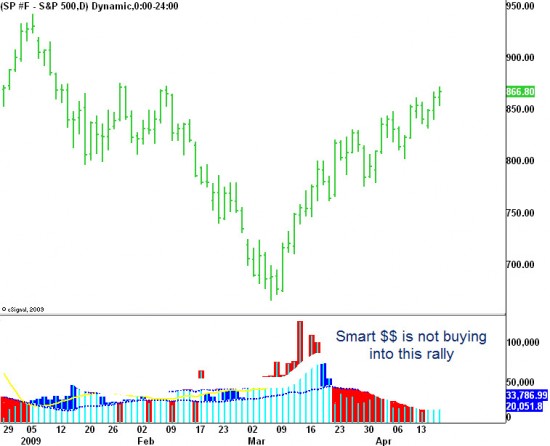
Big Institutional Money Not Participating
What Do the Veterans See
The banking system is no where near being fixed. This week’s Economist sums it up best in their article American banks: Payback time.
“However there is still a danger that the American banking system as a whole is nearly insolvent. And if the stress tests are rigorous, they could show that insolvency is indeed some banks’ likely fate: losses may well eat up much of the system’s capital.”
Silver Lining
There is a silver lining evident in the vast amounts of economic data that I monitor. The tenuous good news: the pace of the recession is beginning to slow. Signs of stabilization have begun to appear. These data points are key. However, we are by no means out of the woods.
The FED sees these signs of stability, but they likely want to drive rates lower one last time. In the chart below, I show a target for the rates on the Ten Year at just below 2%. Since the FED sees we are still thick in the thicket, but can’t lower the fed funds rate any more, they can manipulate rates lower by driving Treasuries higher. The only mind on the street that sees rates going this low is David Rosenberg, outgoing chief economist at Merrill Lynch ($BAC). David shines bright in the spotlight for seeing this whole calamitous situation coming. I wouldn’t fade his opinion at this point.
On the flipside of this trade, rates could break above resistance. Given these crosscurrents, this situation will remain in the closely monitored file.
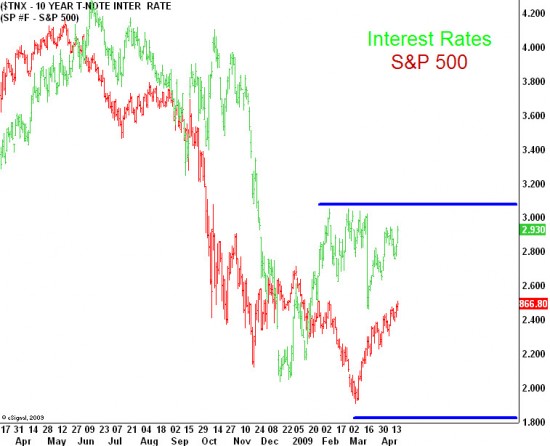
The S&P 500 and Ten Year Rates
Weather Advisory
What is the catalyst? What will spur the sell off in equities, and therein, instigate the rally in bonds, driving rates lower? In the absence of many viable suggestions, I offer some seasonal wisdom that I return to each year: the inverse of the Halloween Indicator.
Perhaps the most important advice in the current “climate”: sell in May and go away. I have never made big gains being long equities during the summer.
Peace


Funny - I was just looking at the volume on the big contract.
Comment by Richard — April 20, 2009 @ 12:45 am
[...] my post from April 19th, Stormy Weather, I noted that the fed can drive rates lower by driving Treasuries [...]
Pingback by How the Fed Will Ease Rates | Trade the Picture — April 22, 2009 @ 11:10 pm
[...] S&P 500 traded in a narrow 10 point range today. The pit was very quiet. As previously chronicled here, the big money has been ominously quiet during this equity run [...]
Pingback by Oficially Leaked - BAC needs $34 Billion | Trade the Picture — May 5, 2009 @ 8:44 pm
RSS feed for comments on this post.
TrackBack URL
https://www.volatilitynews.com/2009/04/stormy-weather/trackback/
Leave a comment