Sunday, April 5, 2026

April 13, 2009

Alan Greespan’s essay on the Gold Standard

This Financial Times article on the Gold Standard debate is making the rounds in trading pits and on the street. The article references a 1960’s essay by Alan Greenspan titled Gold and Economic Freedom. The essay is printed in this collection of essays : Capitalism: The Unknown Ideal. You can also read it by clicking here. Anything by Ayn Rand or Alan Greenspan is highly recommended reading here at Trade the picture.

Peace

Introducing Anything, Anywhere!

1) My confidante, who’s name is Anything, Anywhere!, forwarded me the best article I have read in days, and I read a ton of data. Check out this story via Fil Zucchi at Minyanville.

Conclusion : Most of the REITs are goners. The only X-Factor is the timing. I can’t decide which will be the biggest trade this year. Last year, it was being short the REITs, especially Prologis $PLD. This year, short REITs could be the trade. At the moment, I really like my bond thesis. Short REITs or Long Treasuries? You decide.

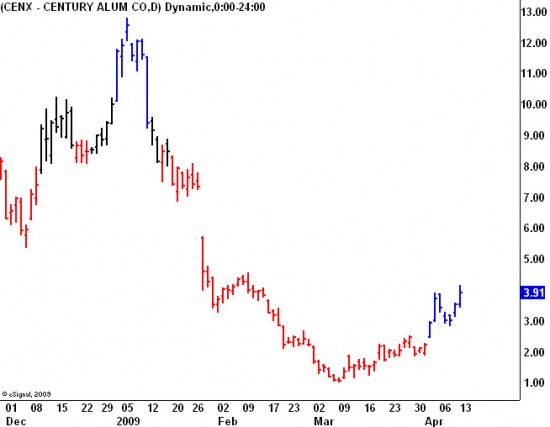
2) Another confidante, who is the only guy I trust to run my money, pointed out a couple of names. The first name is Century Aluminum $CENX. If you feel this rally has more legs, get long the most economically sensitive names. The Base Metals. The second name is Hecla Mining $HL. Precious metals : buy the pullbacks.

Century Aluminum

Century Aluminum

3) The FED is buying Treasuries today. As they drive the price higher, they are driving rates lower.

Peace

April 10, 2009

The Economist Nails It Again

There isn’t much good coverage of the markets in the states. You have to fly over the pond to The Economist, owned by Pearson, a British conglomerate.

This week, The Economist nails it again in it’s article Banks and accounting standards. Messenger, shot.

I could not agree more with their assessment. I quote:

“IN PUBLIC, bankers have been blaming themselves for their troubles. Behind the scenes, they have been taking aim at someone else: the accounting standard-setters. Their rules, moan the banks, have forced them to report enormous losses, and it’s just not fair. These rules say they must value some assets at the price a third party would pay, not the price managers and regulators would like them to fetch. Unfortunately, banks’ lobbying now seems to be working. The details may be arcane, but the independence of standard-setters, essential to the proper functioning of capital markets, is being compromised. And, unless banks carry toxic assets at prices that attract buyers, reviving the banking system will be difficult.

To get the system working again, losses must be recognised and dealt with. Japan’s procrastination prolonged its crisis. America’s new plan to buy up toxic assets will not work unless banks mark assets to levels which buyers find attractive.”

In the states, the financial reporting on television is far too biased. Any financial channel owned by General Electric should be viewed with extreme caution. General Electric $GE is very over leveraged. Knowing they could not make their dividend, they assured everyone they could.

Peace.


Comments (3) Categories: trading

April 8, 2009

Number 9

Number nine, number nine
Industry allows financial imbalance
-The Beatles, Revolution 9

The most important dimension or ‘tell‘ in trading is price itself. There is much to be gleaned from price and price alone. Where is the price? Where was the price? Is the trend up or is the trend down? Price and it’s history are an ever-evolving sketch of this picture.

The second dimension is the voting mechanism: volume. Volume is a very important glimpse into the persuasion of the masses. Without a good read on volume, you may be swimming against the tide–and many a bankroll have been ruined by speculators who throw discipline to the wind in their reckless and futile plunge against the tide.

With price and volume in my quiver, I can now add the third–and possibly the most important–tool in my arsenal: time. Time is a powerful and fundamental implement of the market.

When we look at history, we find rhyming in the timing of things. As I have stated before, and will continue to state, nothing changes in the markets–just the participants.

To weave together some important timing points, I must delve deeper into some specific points in history. Note as we recap some significant market events, that there is definitely a synchronicity in the timing. Reflect further still on the intrigue relevance of the
number 9.

From a religious and philosophical standpoint, 9 has tremendous significance. The number 9 is revered in Hinduism and considered a complete, perfected and divine number because it represents the end of a cycle in the decimal system.

Revolution 9

Revolution 9 was the longest track on the 1968 Beatles Album commonly known as the “White Album.” It played a very crucial role in the infamous “Paul is Dead” controversy. Playing the album backwards as a child, I noticed the oft repeated “number nine” is heard as “Turn me on, dead man.”

Black Friday, 1869

During the American Civil War, the United States government issued a large amount of money that was backed by nothing but credit. After the war ended, people commonly believed that the U.S. Government would buy back the “greenbacks” with gold. -Wikipedia

Sound familiar? THE GOVERNMENT ISSUED A LARGE AMOUNT OF MONEY THAT WAS BACKED BY NOTHING BUT CREDIT. There is certainly a familiar ring to those words in the headlines we read today.

The Crash of 1929

No need to elaborate on this one.

The Day the Music Died

The day the Music died, February 3rd, 1959. Rest in Peace Buddy Holly, Ritchie Valens, The Big Bopper and Roger Peterson.

The spirit of Buddy lives on. He is up there–right where he belongs–with the rest of the stars.

Top Three Buddy Holly (and the Crickets) songs:
1) Not Fade Away
2) Oh Boy!
3) Quando, Quando, Quando

Friday the 13th, 1989

Friday the 13th, 1989 is also known as the Friday the 13th mini crash. It was caused when the $6.75 billion leveraged buyout deal for UAL Corporation, the parent company of United Airlines, fell through.

Which word seems most familiar to todays markets? How about LEVERAGED.

Number 9, Number 9, History doesn’t repeat, but it often rhymes.

Which brings us here, to 2009. History can only be recalled in hindsight, but the number 9 sure has a ton of rhythm. And rhyme.

Peace

The Crash of 1869

The Crash of 1869

April 7, 2009

Top Threee

1) Great article in the economist on the G20 Summit. The Obama effect.

“These days, America’s ties with China probably matter more to the world than the remnants of superpower diplomacy. And on that front, too, the chemistry was good. With China’s President Hu Jintao, Mr Obama agreed that his treasury secretary, Timothy Geitner, would start a Sino-American “strategic and economic dialogue” beginning in Washington, DC, this summer. The Americans said Mr Hu assured them of his commitment to boosting demand as well as improving economic management.”

Conclusion : China and the United States agree. The dollar will be moved higher.

2) For insight into a well facilitated, scripted intervention in the currency markets, I recommend former Treasury secretary Robert Rubin’s Memoir, In an Uncertain World: Tough Choices from Wall Street to Washington.
I have great respect for Rubin. I have heard him called the “greatest secretary of the Treasury since Alexander Hamilton.” I agree.

3) I am you. Was there too. One thing I’d always do. To breakthrough. Picture where I wanna go. Let it manifest. Try my best. Never rest.
-The White Collar Rapper

Peace


Comments (0) Categories: Forex
« Newer PostsOlder Posts »